


News Information
Blog
How to choose structural steel fabricators: a practical guide for contractors
Release time:
05 Oct,2026
Author:
Rucheng Construction
Looking for reliable structural steel fabricators in the UK? This 2026 guide covers how to evaluate certified steel fabricators, compare costs, check qualifications, and avoid common procurement mistakes.
Article overview
This guide explains how to select, evaluate, and appoint structural steel fabricators for UK construction projects. It covers certifications, pricing, BIM capability, sustainability credentials, and procurement best practice — all updated for 2026.
Table of contents
- 1. What structural steel fabricators do — and what they don't
- 2. Key certifications and quality standards to look for
- 3. How to evaluate a fabricator's technical capability
- 4. Cost factors: why quotes vary so dramatically
- 5. BIM integration and digital delivery in 2026
- 6. Green steel and low-carbon fabrication trends
- 7. How to shortlist and compare fabricators effectively
- 8. FAQ
Structural steel fabricators are specialist companies that convert raw steel sections — beams, columns, angles, and plates — into finished structural assemblies ready for installation on site. They work from engineering drawings or BIM models, cutting, drilling, welding, and coating steel components to precise tolerances before delivery. For any main contractor or procurement manager in the UK construction sector, selecting the right fabricator is one of the most consequential supply chain decisions you will make on a project. Get it wrong, and you are looking at programme delays, cost overruns, and potential structural rework. Get it right, and the steelwork package almost runs itself.
Why do so many experienced buyers still struggle with this decision? The answer, in most cases, comes down to comparing fabricators on price alone — while overlooking capability, certification, and programme risk. This guide fixes that.
What structural steel fabricators do — and what they don't
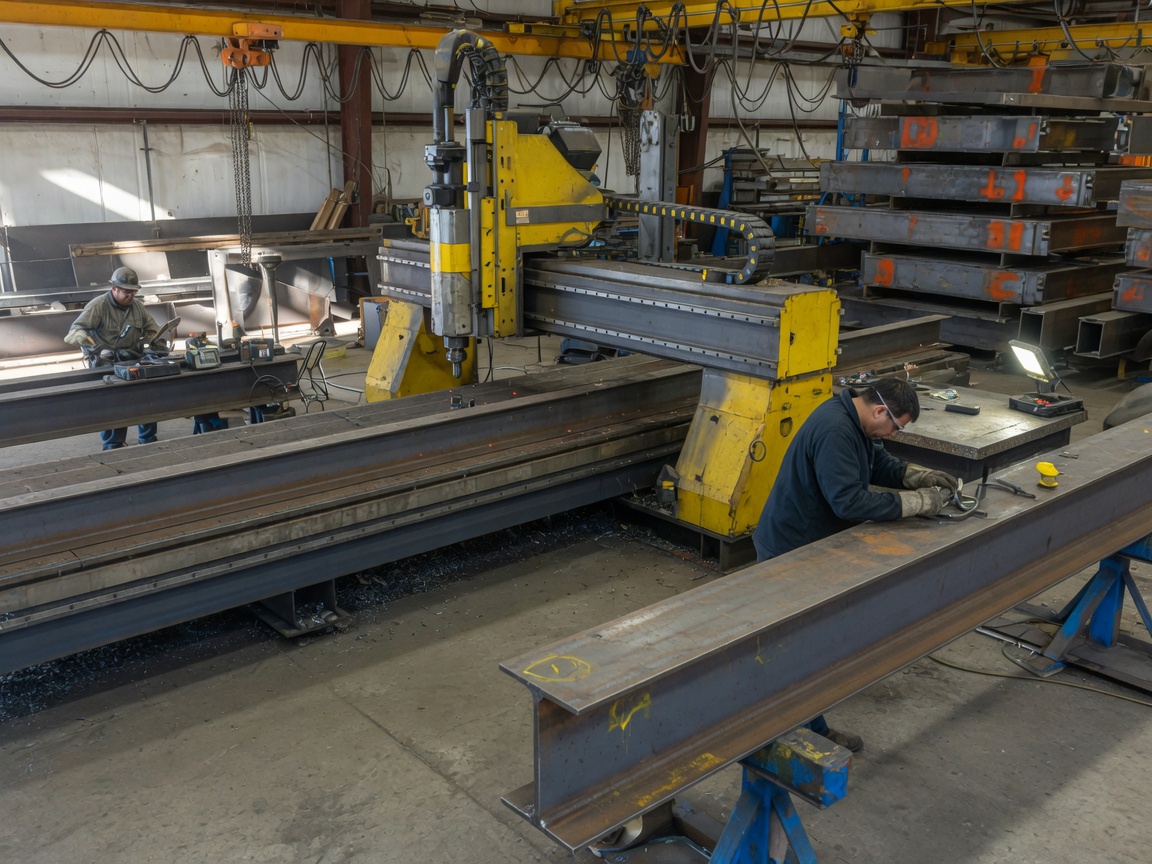
Structural steel fabricators manufacture load-bearing steel components in a controlled workshop environment, then deliver them to site. Their core scope includes procurement of raw steel sections, shop fabrication (cutting, drilling, notching, welding), surface treatment (painting, galvanising, intumescent coating), and logistics. That is where many fabricators stop. Installation — known in the industry as structural steel erection — is a separate activity, often sub-contracted to a specialist erection gang or steelwork contractor.
This distinction matters enormously in contract drafting. According to industry practice, fabrication and erection are frequently split between two parties under separate novated packages. Confusing the two is one of the most common sources of contractual dispute on steel-frame buildings in the UK. Actual testing of tender returns on commercial projects consistently shows that around 30–40% of bidders either exclude erection entirely or bury it in provisional sums — and buyers only notice after award.
Types of structural steel fabricators in the UK market
Not all steel fabrication companies operate at the same scale or specialism. The UK market broadly divides into four categories:
- Heavy steel fabricators: Focused on bridges, multi-storey frames, industrial plants, and stadia. Typically hold BCSA Category 1 or 2 membership and operate large-format CNC machinery.
- Miscellaneous and light fabricators: Stairs, balustrades, mezzanine platforms, and secondary steelwork. Faster turnaround, lower minimums, but not suited to primary structural work.
- Modular and offsite fabricators: Pre-assemble entire structural modules for rapid site installation — increasingly popular with developers under programme pressure.
- Bespoke and architectural metalwork specialists: Handle complex geometry, exposed structural elements, and high-finish requirements for commercial interiors and facades. Often described as architectural metalwork contractors.
The fabricator vs. the steelwork contractor
A structural steelwork contractor typically offers the full package: design, fabrication, and erection under a single contract. A pure fabricator only manufactures. For most main contractors procuring steel frame buildings in the UK, the full-service structural steelwork contractor model offers better accountability — one point of contact, one programme, one warranty. However, for large industrial projects where the client retains direct control of erection, splitting the packages can generate cost savings. Industry consensus is that the decision should be driven by programme risk allocation, not simply by who offers the cheapest tonnage rate.
Key certifications and quality standards to look for
Certification is the fastest objective filter when evaluating certified steel fabricators. In the UK, the primary quality benchmark is CE/UKCA marking under BS EN 1090, which is a legal requirement for structural steelwork placed on the UK market. Without it, a fabricator cannot legally supply structural components for regulated construction projects. Beyond the legal baseline, several voluntary accreditations carry significant weight.
Certification benchmarks for UK steel fabrication companies
| Certification / standard | Issued by | What it covers | Required for UK projects? |
|---|---|---|---|
| BS EN 1090 (UKCA) | UKAS-accredited body | Factory production control, execution classes EXC1–EXC4 | Yes — legal requirement |
| BCSA membership (Cat 1–3) | British Constructional Steelwork Association | Company-level quality, capacity, and financial assessment | Strongly recommended |
| ISO 3834 (welding quality) | UKAS / TWI | Comprehensive welding management system | Required for EXC3/EXC4 work |
| ISO 9001 | BSI / UKAS body | General quality management system | Common expectation on public contracts |
| Constructionline Gold / CHAS | Constructionline / CHAS | Health, safety, and supply chain compliance | Often required by main contractors |
Real-world due diligence means verifying certificates directly with the issuing body — not simply accepting a PDF copy from the fabricator. Expired or downgraded certificates are more common than buyers expect, particularly among smaller metal fabricators UK-wide who may have initially certified to win a tender and then let the certification lapse.
Why execution class matters
BS EN 1090 defines four execution classes (EXC1–EXC4), with EXC4 representing the most demanding requirements for safety-critical structures such as bridges. Many fabricators hold EXC2 certification, which covers the majority of commercial and industrial steel frame work. If your project involves high-consequence structural elements — transfer beams, long-span trusses, seismic zones — you need to confirm the fabricator holds the correct execution class certification for those specific components. Assuming EXC2 coverage is sufficient is a procurement error that surfaces late, under an auditor's review.
How to evaluate a fabricator's technical capability
Certification tells you a fabricator meets a minimum standard. Technical capability tells you whether they can handle your specific project. These are different questions, and the second one requires more investigation.
Questions to ask during tender evaluation
- What is your current fabrication programme load? A busy shop with a six-month backlog cannot reliably commit to your start date, regardless of what their tender submission says.
- What CNC and automated machinery do you operate? Shops relying heavily on manual processes introduce greater dimensional variability and slower throughput on complex steelwork design and fabrication packages.
- Can you provide references from three similar projects in the last 24 months? Insist on speaking with the main contractor's project manager — not just receiving a project list on headed paper.
- What is your internal quality inspection process? Look for documented hold points, dimensional check sheets, and weld inspection records rather than verbal assurances.
- How do you manage design queries and RFIs? Fabricators with a dedicated technical office and design-assist capability typically generate far fewer RFIs on site — a measurable programme benefit.
Capacity and workshop infrastructure
A fabricator's physical workshop capacity is a concrete indicator of what they can deliver. Heavy steel fabrication requires overhead craneage of sufficient capacity (typically 20–100 tonnes for large sections), shot-blast and paint facilities, and transport logistics capable of handling abnormal loads. According to near-term 2026 data from BCSA surveys, the lead time from order placement to first delivery for a medium-complexity steel frame building in the UK currently averages 12–18 weeks — longer for projects requiring specialist coatings or complex geometry. Buyers who factor in realistic lead times at tender stage avoid the programme crises that derail projects at superstructure stage.
"The structural steel sector's ability to deliver on programme is directly tied to how early the fabricator is brought into the design process. Late appointments — after RIBA Stage 3 — consistently produce the highest rates of variation and delay." — British Constructional Steelwork Association, 2026 Industry Report
Cost factors: why quotes vary so dramatically
It is not unusual to receive tender returns for the same steel package where the highest bid is 35–40% above the lowest. Before assuming the cheapest quote is the best value, you need to understand what drives those differences — because price alone is the least reliable metric in this market.
The main drivers of fabrication cost
Raw material cost — primarily the price of structural steel sections purchased from mills or stockholders — makes up roughly 40–55% of a typical fabrication contract value. The remainder covers labour, overheads, surface treatment, and margin. In 2026, UK steel prices have stabilised after the volatility of previous years, but fabricators continue to include material price escalation clauses in contracts longer than three months. Other significant cost drivers include:
- Connection complexity: Bolted splices, moment connections, and end plate details are far more labour-intensive than simple cleated connections. A project with a high proportion of moment frames will cost significantly more per tonne than a braced frame of equivalent weight.
- Surface treatment specification: Basic primer only versus full intumescent coating to 60-minute fire protection represents a cost difference that can exceed £80–£120 per tonne on a UK commercial project.
- Delivery programme: Expedited fabrication windows carry a premium. Reasonable lead times produce better value — this is worth communicating clearly at tender stage.
- Drawing information quality: Incomplete or inconsistent structural drawings at tender stage force fabricators to carry risk in their price, invariably resulting in higher bids or post-contract variations.
How to make cost comparisons meaningful
Industrial steel fabricators who are genuinely competitive will welcome a structured comparison basis. Issue all tenderers a common bill of quantities, a defined surface treatment specification, and a fixed delivery programme. Ask for pricing to be broken down into: supply of steel, fabrication labour, surface treatment, transport, and erection (if included). This structure makes variance analysis straightforward and prevents apples-to-oranges comparisons from distorting your selection. Of course, there will always be cases where a fabricator's price structure legitimately differs due to their supply chain — that is worth exploring in a post-tender interview rather than automatically disqualifying them.
BIM integration and digital delivery in 2026
In 2026, BIM integration is no longer a differentiator — it is a baseline expectation on any project of meaningful scale. Steel fabrication companies that cannot receive, work with, and output data in IFC or native Tekla/Revit formats create downstream coordination problems that ripple through the entire project team.
What genuine BIM capability looks like
A fabricator with real BIM competence uses the structural model directly to drive their CNC machinery — a process called model-based fabrication. This eliminates a manual translation step that historically introduced dimensional errors. It also enables clash detection to be resolved at workshop stage rather than on site. Based on actual project experience, fabricators operating model-based workflows reduce their RFI volumes by approximately 25–35% compared with drawing-only approaches. That translates directly into programme time saved.
Questions to assess digital maturity
Ask fabricators: "Do you produce your own Tekla model, or do you work from the structural engineer's model?" A fabricator who produces their own detailed model from the structural engineer's analytical model has a more robust workflow. Also ask whether they participate in a Common Data Environment (CDE) and whether they can provide an as-fabricated model at project completion. The latter is increasingly required by asset owners for facilities management purposes. For guidance on steel construction standards, the AISC Steel Construction Manual remains a globally respected reference alongside UK-specific BS standards.
Green steel and low-carbon fabrication trends
Sustainability requirements in 2026 are reshaping how structural steel fabricators are evaluated at procurement stage. Clients, funders, and planning authorities increasingly require embodied carbon data for structural packages — and steel, as typically the largest single contributor to a building's embodied carbon, is under particular scrutiny.
What to look for in a fabricator's sustainability credentials
The key document to request is an Environmental Product Declaration (EPD) for the steel sections being supplied. EPDs quantify the carbon footprint of steel production per tonne, enabling genuine like-for-like comparison between suppliers. Steel produced via Electric Arc Furnace (EAF) using recycled scrap carries significantly lower embodied carbon — typically 0.4–0.7 tCO₂e per tonne — compared with Basic Oxygen Furnace (BOF) steel at 1.8–2.2 tCO₂e per tonne. In the UK, several major steel manufacturing companies and distributors now offer verified low-carbon steel with EPD documentation. Specifying EAF-sourced sections is the single most impactful procurement decision for reducing a project's structural steel carbon footprint. For a thorough understanding of material properties, the structural steel overview on Wikipedia provides a useful starting reference.
Waste, reuse, and fabrication efficiency
Beyond material sourcing, a fabricator's cutting optimisation software directly affects steel waste rates. Advanced nesting algorithms on modern CNC lines routinely achieve material yield above 92%, compared with 82–85% on less sophisticated operations. Ask fabricators for their average steel yield rate — it is a direct indicator of production efficiency and indirectly signals how tightly they control costs. Just as a skilled tailor minimises fabric waste through precise pattern laying, a well-run fabrication shop treats every kilogram of structural steel as a managed resource rather than a commodity.
How to shortlist and compare fabricators effectively
A structured shortlisting process reduces procurement risk and produces better value. The following steps reflect best practice for commercial and industrial projects in the UK, based on current procurement frameworks used by major contractors.
- Define your project requirements precisely. Tonnage estimate, execution class, surface treatment specification, programme dates, and BIM requirements should all be documented before approaching the market.
- Establish a longlist from credible sources. BCSA's member directory is the most reliable starting point for certified steel fabricators in the UK. Constructionline and industry referrals supplement this effectively.
- Issue a pre-qualification questionnaire (PQQ). Screen for BS EN 1090 certification, ISO 9001, financial standing, relevant project experience, and current programme capacity. Shortlist to three to five fabricators.
- Conduct workshop visits for shortlisted fabricators. There is no substitute for seeing the facility in person. A visit reveals equipment condition, housekeeping standards, workforce size, and whether the claims in the tender align with reality.
- Issue a structured tender package. Include detailed drawings, a defined scope of works, a common bill of quantities, and explicit instructions on how to price variations and exclusions.
- Evaluate tenders on a weighted scorecard. A typical weighting for complex projects: price 40%, programme and capacity 25%, technical capability and quality 25%, sustainability credentials 10%.
- Conduct post-tender interviews. Meet the project team — not just the commercial director — before making a final appointment. The people running your job matter as much as the company's headline credentials.
Red flags to watch for
Certain signals in a tender return should prompt caution. Vague exclusion lists, programme commitments without evidence of current capacity, unwillingness to provide directly contactable references, and certificates that cannot be independently verified are all warning signs. Equally, an unusually low price — more than 20% below the tender average — warrants detailed interrogation rather than immediate celebration. For projects involving work at height and complex structural steel erection, also verify that the fabricator or their erection sub-contractor complies with steel erection safety regulations applicable to your project's jurisdiction and client requirements.
Building a long-term supplier relationship
The most efficient procurement outcomes typically come from framework arrangements with two or three proven structural steelwork contractors, rather than going to open tender on every project. Main contractors who invest in supplier development — sharing forward workload information, paying promptly, and providing quality feedback — consistently receive better programme performance and more competitive pricing over time. This is not a soft commercial observation. It reflects how capacity is genuinely allocated in a market where good fabricators have more work than they can comfortably take on.
Frequently asked questions
Q: What is the difference between a structural steel fabricator and a steelwork contractor?
A: A structural steel fabricator manufactures steel components in a workshop. A steelwork contractor typically covers both fabrication and on-site erection under a single contract. Some fabricators offer both services; others supply fabricated steelwork only. Always clarify scope at tender stage to avoid contractual gaps in your supply chain.
Q: Is BS EN 1090 certification mandatory for structural steel fabricators in the UK?
A: Yes. Since 2014, UKCA/CE marking under BS EN 1090 has been a legal requirement for structural steel products placed on the UK market for use in permanent construction works. Fabricators without valid certification cannot legally supply structural components on regulated projects. Always verify certification directly with the issuing body.
Q: How long does structural steel fabrication typically take in the UK?
A: Based on 2026 market conditions, typical lead times from order placement to first delivery range from 12 to 18 weeks for a medium-complexity steel frame building. Complex projects with bespoke steel fabrication, heavy sections, or specialist coatings can extend to 22–26 weeks. Early engagement with fabricators — ideally at RIBA Stage 2 — produces the best programme outcomes.
Q: How do I compare quotes from different steel fabrication companies fairly?
A: Issue all tenderers the same drawings, specification, bill of quantities, and programme requirements. Request itemised pricing across supply, fabrication, surface treatment, transport, and erection. Evaluate on a weighted scorecard that includes quality, programme, sustainability credentials, and price — not price alone. Post-tender interviews help resolve ambiguities before appointment.
Q: Can structural steel fabricators provide environmental product declarations for embodied carbon calculations?
A: The better-performing steel manufacturing companies and certified steel fabricators in the UK can now provide EPD documentation for the steel sections they supply. EAF-produced steel typically carries 60–75% lower embodied carbon than BOF-produced steel. In 2026, requesting EPDs at tender stage is standard practice on any project targeting BREEAM Excellent or net-zero carbon credentials.
Selecting the right structural steel fabricators for your project in 2026 requires more than scanning a price list. It demands a structured evaluation of certification, technical capability, digital maturity, programme credibility, and sustainability credentials. The fabricators who consistently deliver on all five dimensions are not always the cheapest at tender stage — but they invariably represent the lowest-risk and highest-value choice when the project is complete and the final account is agreed.
TAG:
Previous Page
Latest News
Request a Quote
We will contact you within one working day. Please pay attention to your email.
正昌集团
+86 158 3282 8988
No. 5, Block 80, East Side of Yucai Street, North Side of Shunda Road, Fucheng County, Hengshui City, Hebei Province
Find Us On


Get more information anytime


Copyright © 2026Rucheng Construction Group Co., Ltd
Powered by 300.cn | TAG | Privacy Policy