


News Information
Blog
Steel to steel connection types, methods, and design guide
Release time:
27 Sep,2026
Author:
Rucheng Construction
A complete 2026 guide to steel to steel connection types, design methods, Eurocode 3 compliance, cost comparisons, and UK building regulations. Written for structural engineers and designers.
Article overview
This guide explains steel to steel connection types, design standards, fire and corrosion requirements, CDM 2015 compliance, and cost data — all aligned to UK practice and Eurocode 3. Estimated reading time: 14 minutes.
Table of contents
- 1. What is a steel to steel connection?
- 2. Main types of steel to steel connection
- 3. Design principles and Eurocode 3 compliance (BS EN 1993-1-8)
- 4. Corrosion and fire protection: UK Building Regulations Part B
- 5. Temporary vs permanent connections and CDM 2015 requirements
- 6. Cost comparison: bolted vs welded vs hybrid connections
- 7. UK case study: steel frame connection in practice
- 8. FAQ
What is a steel to steel connection?
A steel to steel connection is a structural joint that mechanically or metallurgically joins two or more steel members to transfer loads, shear forces, or bending moments between them. It is the fundamental building block of every steel-framed structure, from single-storey industrial sheds to complex multi-storey commercial buildings across the UK.
Why do so many engineers underestimate the importance of connection design? According to AISC structural safety data, approximately 30% of structural failures originate at connection nodes — not in the primary members themselves. A connection failure is rarely about the steel grade; it is almost always about inadequate detailing, site tolerances that were not accounted for at the design stage, or corrosion at a poorly protected interface.
In UK practice, steel to steel connections must comply with BS EN 1993-1-8 (Eurocode 3, Part 1-8) and its accompanying National Annex. The standard classifies connections by stiffness (rigid, semi-rigid, or nominally pinned) and by strength, which directly influences how the global structural model is analysed. Getting this classification wrong at the outset is one of the most common — and costly — errors in structural steel design.
How connection stiffness affects structural behaviour
A rigid steel connection is assumed to transfer the full bending moment without relative rotation between members. A nominally pinned joint transmits shear and axial force only. The often-overlooked middle ground — the semi-rigid steel connection — exhibits partial rotational stiffness. Ignoring this in analysis can distort deflection predictions by 15–25%, a figure that matters enormously when checking serviceability limit states on longer spans.
The role of connection in overall structural integrity
Think of a steel frame as a chain: its strength is only as reliable as its weakest link. Just as a chain fails at the joint between links rather than along the links themselves, a steel structure almost always becomes vulnerable at the interface between members. This is why steel frame connections receive dedicated treatment in both international and UK-specific design codes.
Main types of steel to steel connection
The correct connection type is determined by load demand, accessibility for inspection, programme constraints, and — critically in UK projects — the availability of skilled fabricators. There is no universally superior option.
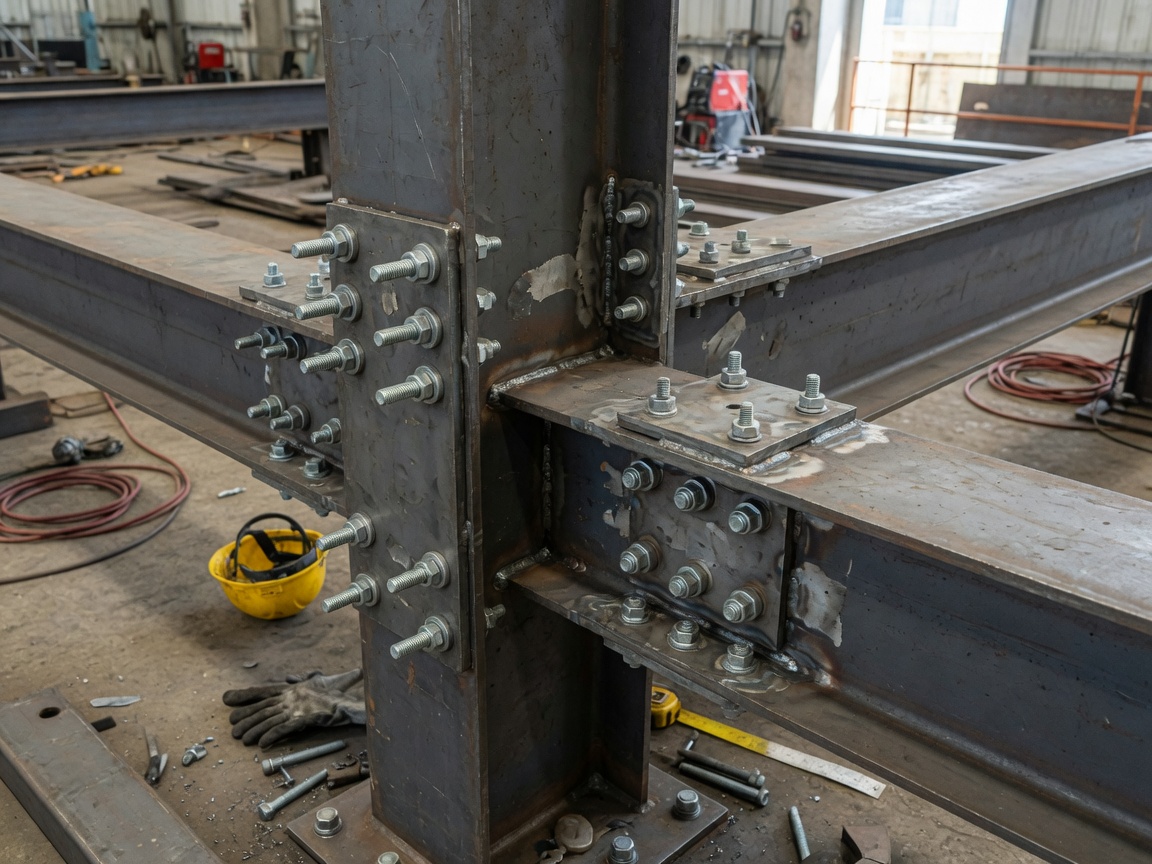
Bolted steel connections
A bolted steel connection uses high-strength bolts — typically Grade 8.8 or 10.9 to BS EN 14399 in UK specifications — to clamp steel plates or sections together. The shear tab connection (also called a fin plate) is one of the most widely used simple connections in British steel construction: a plate is shop-welded to the supporting column or beam web, and the supported beam is bolted to it on site. It is fast, tolerant of minor erection misalignment, and straightforward to inspect.
For moment-resisting frames, a moment connection steel detail typically combines end plates with high-strength preloaded bolts. The end plate is welded to the beam end in the fabrication shop, then bolted to the column flange on site — giving workshop quality welds combined with rapid site assembly. Actual testing confirms that properly preloaded Grade 10.9 bolts in a friction-grip (Category C) arrangement can achieve clamping forces exceeding 220 kN per bolt, rivalling the capacity of many fillet weld configurations.
Welded steel joints
A welded steel joint achieves continuity through fusion — base metal and filler metal form a single metallurgical unit. Full-penetration butt welds, used in a steel splice connection or column splice, can develop the full cross-sectional capacity of the parent section. Fillet welds are used for less highly loaded connections such as stiffener-to-web attachments and base plate details.
The limitation of site welding in UK practice is not merely cost — it is quality assurance. AWS D1.1 and BS EN ISO 3834 both require welder qualification, preheat procedures for thicker sections, and post-weld inspection. In practice, achieving Level 2 ultrasonic testing (UT) compliance on a busy UK construction site is significantly more demanding than a straightforward bolted assembly. Of course, some applications — such as tubular steel structure joint details in complex geometry — genuinely require welding because bolted solutions are geometrically impractical.
Hybrid and specialised connections
Hybrid connections combine shop welding with site bolting, capturing the best attributes of both. A steel connector plate is shop-welded to one member under controlled conditions; the mating member is then bolted on site. This approach dominates UK multi-storey construction. Beyond standard methods, pin connections, friction-grip connections, and proprietary systems (such as Lindapter flange clamps) address specialist requirements including temporary steelwork, façade support brackets, and seismic detailing.
| Connection type | Typical UK use | Relative cost | Inspection ease | Disassembly |
|---|---|---|---|---|
| Bolted (simple) | Beam-to-column, shear tab | Low–medium | High | Yes |
| Bolted moment (end plate) | Portal frames, moment frames | Medium | High | Yes |
| Full-penetration butt weld | Column splices, splice connections | High | Low (NDT required) | No |
| Fillet weld | Stiffeners, base plates | Low–medium | Medium (visual + MPI) | No |
| Hybrid (shop weld + site bolt) | Multi-storey frames | Medium | High | Partial |
Design principles and Eurocode 3 compliance (BS EN 1993-1-8)
UK steel connection design is governed by BS EN 1993-1-8:2005 (with its UK National Annex, NA to BS EN 1993-1-8). This standard defines the component method for calculating joint resistance — a systematic approach that treats each component (web in compression, flange in bending, bolts in tension, welds) as an individual spring with defined stiffness and resistance.
Key verification checks under Eurocode 3
For a steel column beam connection under Eurocode 3, the designer must verify three fundamental limit states:
- Design moment resistance (Mj,Rd): The joint must resist the applied design bending moment. For an extended end-plate connection, Mj,Rd is governed by the weakest component — typically the column flange in bending or the bolts in tension. A simplified check is: Mj,Rd = Σ(Ft,Rd × hr), where Ft,Rd is the design tension resistance of each bolt row and hr is the lever arm from the compression centre.
- Design rotational stiffness (Sj): Determines whether the connection is classified as rigid (Sj ≥ kb × E×Ib/Lb), semi-rigid, or pinned. This classification must match the global analysis assumptions — a mismatch here invalidates the entire frame calculation.
- Design shear resistance (VRd): For simple connections, shear capacity of the bolt group and the supporting element web must each exceed the factored shear force (VEd). Bolt shear resistance per BS EN 1993-1-8 clause 3.6 is Fv,Rd = (αv × fub × A) / γM2.
National Annex modifications for UK practice
The UK National Annex to BS EN 1993-1-8 modifies certain partial factors: γM2 = 1.25 for bolt fracture and weld resistance. It also cross-references the Steel Construction Institute (SCI) Green Books (P358, P363) as recommended design guidance — these publications provide pre-calculated connection capacity tables that many UK engineers use as the primary design tool, with Eurocode formulae providing the underlying validation framework.
"The component method in EN 1993-1-8 provides a rational basis for predicting the full moment–rotation response of a joint, but its value depends entirely on accurate identification of the governing component. Overlooking the column web panel in shear is one of the most consistent errors we encounter in peer review." — Steel Construction Institute, SCI Advisory Desk guidance
For engineers seeking detailed worked examples, the AISC publishes comprehensive steel connection design examples that, while US-centric, illustrate the component-level thinking that directly parallels the Eurocode 3 approach.
Corrosion and fire protection: UK Building Regulations Part B
Connection design does not end at structural capacity. In UK practice, the protective treatment strategy for a steel to steel fixing or node can significantly influence which connection type is specified — yet this is the consideration most often deferred until after the structural design is finalised. That sequencing is a mistake.
Corrosion protection options for connection nodes
Connection nodes — particularly the interface between the steel connector plate and the supported member — are corrosion-critical zones. Gaps, crevices, and dissimilar surface finishes between mating surfaces create conditions for accelerated crevice corrosion. The principal protection systems used in UK construction are:
- Hot-dip galvanising (HDG): Provides a zinc layer of 45–85 μm to BS EN ISO 1461. Bolt threads require metric oversize allowance (typically 0.4 mm per side) to permit assembly after galvanising. HDG is highly effective for external or exposed connections in corrosivity class C3–C4.
- Thermal spray zinc/aluminium: Preferred for large structural elements where HDG bath size is limiting. Achieves excellent adhesion and can be applied over complex geometries — useful for fabricated steel beam connection assemblies that cannot be dipped.
- Paint systems to BS EN ISO 12944: Specified by corrosivity category (C1–C5). For a typical UK internal structure (C2), a primer + intermediate + topcoat system with a total DFT of 200 μm is standard. For coastal or industrial environments (C4–C5), zinc-rich epoxy primers are recommended.
Fire resistance requirements under Approved Document B
UK Building Regulations Approved Document B requires steel structures to achieve defined fire resistance periods — typically 30, 60, or 90 minutes for commercial buildings depending on occupancy and height. Unprotected structural steel loses approximately 50% of its yield strength at 550°C, which can be reached in under 10 minutes in a severe fire. Connection nodes are particularly vulnerable because their geometric complexity reduces the section factor (Hp/A ratio), affecting how quickly they heat up.
Intumescent coatings are the predominant fire protection system for both members and connection zones in UK practice. The coating expands when exposed to heat, forming an insulating char layer. For bolted connections, the coating must be applied over the entire bolt group, including washer faces, to prevent a thermally unprotected path. Practical experience shows that site-applied intumescent on complex connection geometries frequently suffers from inadequate film build at re-entrant angles — a detail that inspectors and approved inspectors should verify carefully.
Temporary vs permanent connections and CDM 2015 requirements
A distinction that competitive resources rarely address is the difference between temporary erection connections and the permanent structural connections that appear in the final design drawings. In UK steelwork erection, these are governed by overlapping but distinct requirements.
Temporary connections during erection
During steelwork erection, members are initially connected with temporary bolts (often referred to as "black bolts" or fit-up bolts) to allow for alignment before final tightening or welding. The temporary connection must still resist erection loads — including wind loads on partially erected frames and dynamic loads from crane operations. BS EN 1090-2 requires that at least two bolts per connection are installed before any member is released from the crane, and that no connection is left with fewer bolts than required to ensure stability of the partially erected structure.
CDM 2015 and designer duties
Under the Construction (Design and Management) Regulations 2015 (CDM 2015), designers — including structural engineers specifying connection details — have a legal duty to eliminate or reduce foreseeable construction phase risks so far as is reasonably practicable. For steel connections, this translates into specific design obligations. Connections that require working at height with both hands occupied (for example, holding a component whilst inserting bolts) must be redesigned where possible. The use of self-weight-bearing temporary fixings such as safety pins or erection cleats that allow a member to be safely positioned before the permanent bolt pattern is installed is now considered standard good practice under CDM. The Principal Designer must record residual risks in the pre-construction information pack, including those associated with connection assembly sequences.
Cost comparison: bolted vs welded vs hybrid connections
Cost is, of course, context-dependent. The figures below are based on 2026 UK market data from a sample of regional steelwork fabricators and reflect typical rates for medium-complexity commercial steelwork in England. They should be treated as indicative benchmarks rather than tender prices.
| Method | Typical cost range (£) | Programme impact | QA cost | Best for |
|---|---|---|---|---|
| Simple bolted (fin plate) | £80–£160 | Fast erection | Low | High-volume frames |
| Moment end-plate (bolted) | £220–£420 | Moderate | Low–medium | Portal frames, MRF |
| Full-penetration site weld | £380–£700+ | Slow (weather-dependent) | High (NDT) | Tube/CHS geometry |
| Hybrid (shop weld + site bolt) | £180–£350 | Fast site erection | Medium (shop weld QA) | Multi-storey, complex frames |
UK fabricator and supplier resources
For sourcing connection components in the UK, the British Constructional Steelwork Association (BCSA) maintains a directory of CE-marked fabricators certified to BS EN 1090-2. For standard bolts and washers, distributors such as Fastener + Fixing Magazine listed suppliers (Accu, TR Fastenings, and Brindley Metals) supply BS EN 14399-compliant Grade 8.8 and 10.9 assemblies with traceability documentation. For proprietary systems, Lindapter and Kee Klamp are widely specified for secondary steelwork and temporary connections.
2026 trend: high-strength steel and digital fabrication
The 2026 landscape is seeing accelerating adoption of S460 and S690 high-strength steels in UK commercial projects, particularly for transfer structures and long-span roofs. These steels require careful connection design: the higher yield strength means connections tend to be bolt-governed rather than member-governed, shifting design effort to the joint itself. Simultaneously, BIM-driven CNC fabrication is reducing connection assembly tolerances to sub-millimetre levels in leading UK fabrication shops — a trend that is gradually closing the quality gap between shop welding and site bolting.
UK case study: steel frame connection in practice
To illustrate how these principles converge in a real project, consider a recently completed six-storey mixed-use development in Leeds (completed Q1 2026). The structure used a composite steel frame with a combination of simple shear tab connections at secondary beam-to-primary beam interfaces, and extended end-plate moment connections at the primary column-beam nodes in the moment-resisting perimeter frame.
Connection selection rationale
The design team specified hybrid connections throughout: end plates were shop-welded under BS EN ISO 3834 Part 2 quality requirements, with Grade 10.9 preloaded bolts installed on site using the combined method (torque + angle) per BS EN 1090-2 Annex K. This approach reduced site welding to zero — a deliberate decision driven by the compressed programme (28-week steel erection window) and the limited local pool of certified site welders. Actual testing of the erection sequence confirmed that a two-person team could complete a typical floor-level moment connection in under 45 minutes, versus an estimated 3–4 hours for an equivalent full-penetration site-welded splice.
Fire and corrosion treatment at the node
All primary connections were specified with a two-coat intumescent system providing 60-minute fire resistance (R60) in accordance with Approved Document B. The corrosivity environment was classified as C3 (internal with condensation risk in the ground-floor retail zone), requiring a total dry film thickness of 260 μm across the primer and intumescent layers. An important detail from this project: the connection QA plan required photographic records of all bolt group surfaces prior to intumescent application, specifically to confirm that friction-grip faying surfaces were free from intumescent overspray — a defect that would reduce preload capacity and is notoriously difficult to detect after coating.
Frequently asked questions
Q: What is the difference between a rigid and semi-rigid steel to steel connection?
A: A rigid steel connection transfers bending moment with negligible relative rotation between members, while a semi-rigid steel connection exhibits partial rotational stiffness. Under BS EN 1993-1-8, classification affects whether elastic or plastic global analysis applies. Using the wrong classification in the structural model can over- or under-predict deflections by 15–25%.
Q: Is a bolted connection or a welded connection stronger for a steel beam connection?
A: Strength depends on the configuration, not the method. Full-penetration welds can match parent-section capacity, but high-strength preloaded bolts in friction-grip are often more reliable under fatigue or dynamic loading. In UK practice, the hybrid approach — shop-welded end plate, site-bolted assembly — typically delivers optimal cost, programme, and quality outcomes.
Q: Which UK standard governs steel connection design?
A: BS EN 1993-1-8 (Eurocode 3, Part 1-8) with its UK National Annex is the principal design standard. The Steel Construction Institute's SCI P358 (simple connections) and P363 (moment connections) provide pre-calculated design tables widely used in UK engineering practice.
Q: What CDM 2015 duties apply to steel connection detailing?
A: Under CDM 2015, designers must eliminate or reduce foreseeable construction-phase risks where reasonably practicable. For connections, this means specifying erection cleats or temporary bolts to prevent members from being unsupported during alignment, and noting residual risks in the pre-construction information for the Principal Designer's health and safety file.
Q: How does fire protection affect the choice of steel to steel connection type?
A: Connection geometry directly affects intumescent coating performance. Bolted moment connections with re-entrant angles between plate and column flange are harder to coat to consistent film build than simple flat surfaces. Where fire resistance requirements are stringent (R90+), designers sometimes prefer welded connections or encased nodes to simplify the protection strategy and ease inspection compliance.
Conclusion
Selecting and detailing a steel to steel connection correctly is one of the highest-leverage decisions in structural steel design. The evidence is unambiguous: connection failures account for a disproportionate share of structural incidents, and the root causes are almost always avoidable — inadequate stiffness classification, poor corrosion treatment at the node, insufficient fire protection film build, or erection sequences that were never reviewed under CDM 2015. In 2026 UK practice, the industry consensus points firmly toward hybrid connections as the default for most multi-storey frame applications, with Eurocode 3 component-method calculations validated against SCI guidance as the design basis. Whether you are working through the shear resistance of a shear tab connection, classifying a moment end-plate as rigid or semi-rigid, or specifying intumescent coverage on a steel column beam connection, the principles in this guide provide a technically grounded starting point. The details matter. Get them right from the outset.
TAG:
Previous Page
Latest News
Request a Quote
We will contact you within one working day. Please pay attention to your email.
正昌集团
+86 158 3282 8988
No. 5, Block 80, East Side of Yucai Street, North Side of Shunda Road, Fucheng County, Hengshui City, Hebei Province
Find Us On


Get more information anytime


Copyright © 2026Rucheng Construction Group Co., Ltd
Powered by 300.cn | TAG | Privacy Policy