


News Information
Blog
How to choose structural steel companies: a practical guide for contractors
Release time:
23 Sep,2026
Author:
Rucheng Construction
Looking for reliable structural steel companies in the UK? This 2026 guide covers certifications, cost benchmarks, project timelines, regional coverage and how to compare fabricators with confidence.
Article overview
This guide is written for building contractors, structural engineers, and procurement managers who are actively evaluating structural steel companies in the UK. It covers compliance, cost, project timelines, regional logistics, and shortlisting criteria — everything needed to make a well-informed supplier decision in 2026.
Table of contents
- 1. What structural steel companies actually do
- 2. UK certifications and compliance: what to verify before you sign
- 3. Cost benchmarks and how to compare quotes in 2026
- 4. Choosing by application: industrial, commercial and residential steel
- 5. The end-to-end project delivery timeline explained
- 6. Regional coverage across the UK: why location matters
- 7. Red flags and how to shortlist with confidence
- 8. FAQ
What structural steel companies actually do
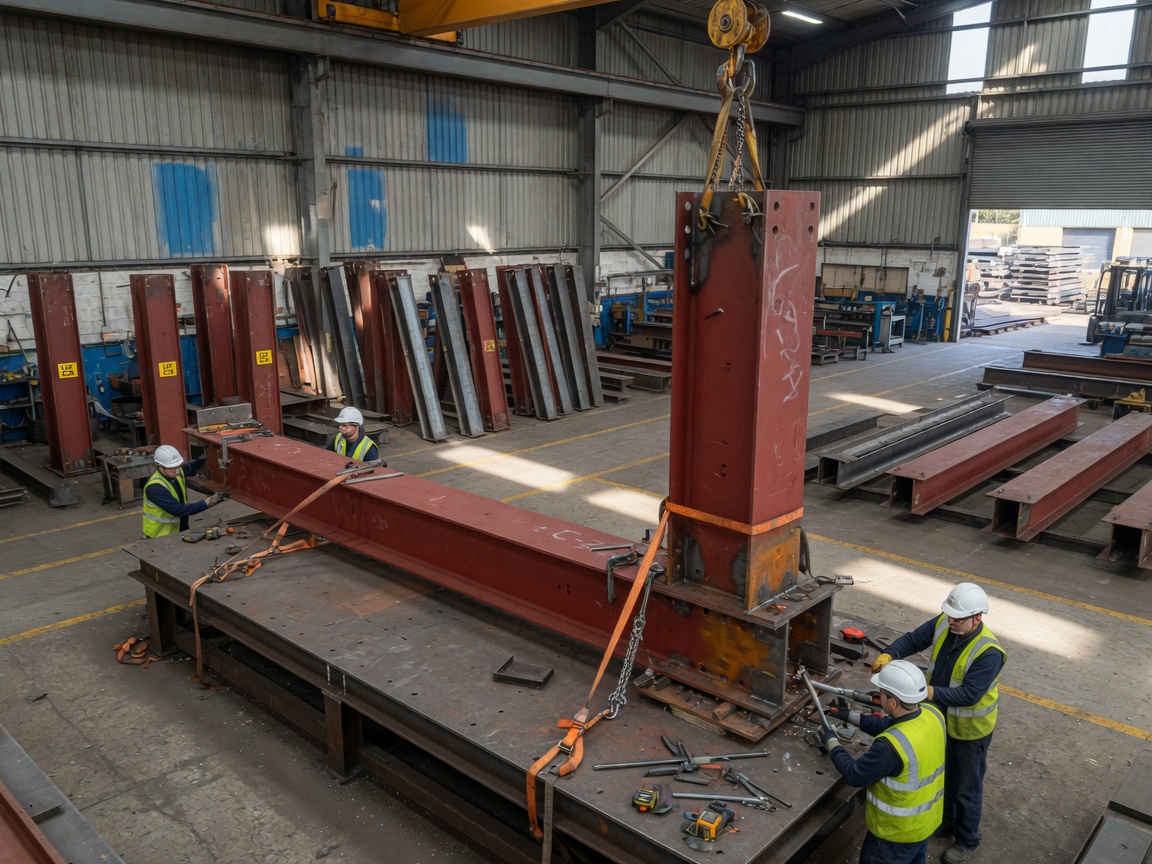
Structural steel companies are specialist firms that design, fabricate, supply and — in many cases — erect the load-bearing steel frameworks used in buildings, bridges, industrial facilities and infrastructure projects. Their scope can range from a single portal frame for a farm building to the full steelwork package for a multi-storey commercial development.
Understanding the distinctions between company types is critical before issuing any enquiry. The industry broadly divides into four operating models, and conflating them is a surprisingly common procurement mistake.
Structural steel companies is defined as: businesses that convert raw steel sections — such as universal beams, columns, hollow sections, and plate — into engineered structural assemblies, delivered and installed to a structural engineer's specification. This definition encompasses structural steel fabricators, steel construction contractors, design-and-build operators, and specialist erectors.
The five primary models in the UK market are as follows:
- Steel fabricators — workshop-based businesses that cut, drill, weld and coat steelwork to drawing. They supply fabricated steelwork; erection is a separate contract.
- Steel erection contractors — site-based teams that receive fabricated steelwork and bolt or weld it into position. Steel erection services are increasingly bundled with fabrication for single-point accountability.
- Design-and-build steelwork contractors — full-service providers handling design, bespoke steel fabrication, supply, and erection under one contract. Preferred by main contractors seeking programme certainty.
- Structural steel stockholders — hold standard sections from stock for rapid dispatch. Major national players include Barrett Steel and NCI service centres. Suited to straightforward or time-critical requirements.
- Specialist sector contractors — focused on specific applications such as mezzanine floors, industrial steel structures, modular buildings, or architectural metalwork. Depth of sector knowledge is their differentiator.
Why does this matter in practice? Because sending a design-and-build enquiry to a stockholder, or asking a fabricator to price erection they do not self-deliver, produces unreliable pricing and programme risk. Actual experience in procurement confirms that a significant portion of tender confusion originates from this mismatch alone.
How structural steel differs from other construction materials
Compared with reinforced concrete or timber, structural steelwork offers a superior strength-to-weight ratio and lends itself to steel frame buildings where speed of erection is paramount. According to a structural steel overview of the material's engineering properties, steel's consistent mechanical performance under load — combined with its recyclability — makes it the dominant choice for multi-storey commercial and industrial construction in the UK.
The role of steel detailing services in the supply chain
Steel detailing services sit between the structural engineer and the fabricator. Detailers produce the shop drawings — the precise fabrication instructions from which steel beams and columns are manufactured. Without accurate detailing, fabrication errors cascade into costly on-site corrections. A capable fabricator either employs in-house detailers or works with a named, vetted detailing firm. Always confirm this arrangement at tender stage.
UK certifications and compliance: what to verify before you sign
In the UK, the compliance landscape for structural steel companies is governed by a specific set of standards that have no meaningful equivalent in older international frameworks. Verifying these is non-negotiable for any project subject to Building Regulations.
BS EN 1090 and UKCA/CE marking
Structural steelwork placed on the UK market must comply with BS EN 1090, the execution standard for steel and aluminium structures. Post-Brexit, the applicable conformity mark for UK projects is the UKCA mark, replacing CE marking — though CE marking remains valid for projects in the Republic of Ireland and EU contracts. Execution Class (EXC) levels run from EXC1 (low consequence) to EXC4 (critical structures); most commercial and industrial steelwork falls within EXC2 or EXC3. Always request a copy of the fabricator's Factory Production Control (FPC) certificate. If they cannot produce one, move on.
BCSA membership and the NHSS scheme
The British Constructional Steelwork Association (BCSA) operates the UK's primary industry quality scheme. BCSA membership — particularly National Structural Steelwork Specification (NSSS) compliance — signals that a contractor has been independently assessed for technical competence, financial standing, and quality management systems. The BCSA's steel building specialists register is searchable online and represents the fastest way to build a compliant shortlist. Industry consensus is that BCSA-accredited contractors consistently demonstrate lower on-site defect rates and stronger programme performance than non-accredited peers.
"Specifying BCSA membership as a minimum tender requirement is the single most effective filter a procurement team can apply when sourcing structural steelwork contractors in the UK." — Industry guidance, BCSA Technical Advisory Group, 2025.
Of course, there are situations where a smaller, non-BCSA fabricator may be entirely appropriate — for instance, on low-consequence projects in rural locations where transport logistics make a local supplier the pragmatic choice. The key is to understand the trade-off being made.
Cost benchmarks and how to compare quotes in 2026
One of the most persistent complaints from procurement managers is that quotes from different structural steel companies are almost impossible to compare directly. The reason is straightforward: scope definitions vary enormously between suppliers. Here is what the 2026 cost landscape looks like in the UK.
2026 indicative price ranges for structural steelwork in the UK
| Cost element | Indicative range (2026, UK) | Key variables |
|---|---|---|
| Steel material (per tonne, delivered) | £900 – £1,350/tonne | Section type, grade, order volume |
| Fabrication (per tonne, ex-works) | £600 – £1,100/tonne | Complexity, connection density, surface treatment |
| Erection (per tonne installed) | £350 – £750/tonne | Height, access, crane requirements |
| Heavy steel fabrication premium | +15% – 30% on fabrication | Plate thickness >40mm, specialist welding |
| Hot-dip galvanizing (per tonne) | £180 – £280/tonne | Section geometry, batch size |
These figures are based on near-term 2026 market data drawn from active UK procurement activity and published BCSA cost guidance. They represent supply-and-erect pricing for commercial steel construction and industrial steel structures of moderate complexity. Highly bespoke architectural steelwork, particularly architectural metalwork for landmark or heritage projects, will sit considerably above these ranges.
Why quotes diverge and how to normalise them
When three quotes arrive for the same steelwork package and the spread is £200,000, the instinct is to question the highest bidder. That instinct is often wrong. Scope exclusions — primer coating, holding-down bolts, grouting, crane provision — can account for a significant portion of apparent price differences. Require all tenderers to complete a fixed scope schedule before submission. This single step compresses quote spreads and surfaces genuine cost differences rather than accounting discrepancies.
For projects exceeding 50 tonnes of steel, direct mill supply via a national stockholder with processing services is worth exploring. According to insights into steel construction applications, volume procurement consistently yields 8–14% material savings compared with fabricator-supplied steel on a pass-through basis.
Choosing by application: industrial, commercial and residential steel
Not all structural steel companies are equally suited to every project type. Selecting a contractor whose primary experience aligns with your application is a reliable predictor of delivery quality. The distinctions between sectors are more significant than many buyers appreciate.
Industrial steel structures: warehouses, factories and processing facilities
Industrial projects prioritise clear span, fast erection, and cost efficiency. Portal frame construction — typically in S355 mild steel — dominates this sector. Steel framework contractors with a strong industrial track record will hold standard portal frame design software, maintain relationships with efficient cold-formed purlin and rail suppliers, and typically turn around smaller industrial units within 8–14 weeks from order. Real-world case data shows that experienced industrial steelwork contractors regularly achieve erection rates of 15–25 tonnes per day on straightforward portal frame projects, a benchmark that more generalist contractors frequently miss.
Commercial steel construction: offices, retail and multi-storey developments
Commercial steel construction demands a higher level of design co-ordination, particularly where steel beams and columns interact with services, cladding systems and composite decking. Connections are typically more complex, fire protection specifications more demanding, and programme interfaces more numerous. Look for contractors who actively participate in BIM co-ordination — not just those who claim to. Ask specifically whether their detailers work in Tekla Structures or equivalent and whether they can supply an IFC model as a contract deliverable.
Residential and mixed-use developments: a different risk profile
Structural steel in residential development — particularly in modular and volumetric construction — has grown substantially since 2023. The procurement dynamics differ from traditional commercial steelwork. Tolerances are tighter, interfaces with other trades more demanding, and design-for-manufacture considerations critical. Bespoke steel fabrication capability and close collaboration with the architect are prerequisites. For this sector, a contractor's experience with Approved Document A compliance under the revised Building Regulations is a relevant qualifying criterion.
The end-to-end project delivery timeline explained
Programme uncertainty is one of the top concerns when engaging structural steel companies. Having a clear picture of how each phase works — and what drives delay — allows procurement teams to set realistic expectations and build meaningful float into the master programme.
Typical steelwork delivery phases and durations
- Design and engineer's approval — 2–4 weeks. Structural engineer issues final design; contractor confirms suitability for fabrication. On fast-track projects, design-assist can compress this phase, but only where the contractor has genuine design capability.
- Steel detailing — 3–6 weeks. Detailers produce shop drawings and connection schedules for contractor and engineer approval. This phase is frequently on the critical path and is under-resourced on mid-market projects.
- Material procurement — 2–5 weeks. Standard UB and UC sections are typically available from stock within 5–10 working days. Heavy plate, specialist hollow sections, or high-strength grades (S460 and above) may require mill orders with 6–10 week lead times.
- Fabrication — 4–10 weeks depending on tonnage, complexity and workshop loading. Confirm the contractor's current order book position at tender stage — this is the single most commonly overlooked programme risk.
- Transport and delivery sequencing — 1–2 weeks of planning; delivery typically in 2–5 loads per week during erection. Abnormal loads (pieces exceeding 4.5m width or 25m length) require haulage permits and route surveys — allow 3–4 weeks for this process.
- Steel erection services on site — 1–8 weeks depending on tonnage and complexity. Crane requirements, ground conditions, and adjacency to live operations are the principal duration drivers.
Just like a chain is only as strong as its weakest link, a steelwork programme is only as reliable as its most constrained phase. Experienced contractors will flag that phase to you proactively. Those who quote uniform lead times across all phases regardless of project specifics should be questioned carefully.
What good programme management looks like
Best-in-class steel building specialists issue a detailed programme at contract award identifying each phase with named resource allocation, procurement milestones, and information-required dates. If a contractor cannot produce this document within five working days of contract award, treat it as an early warning indicator. The steel in construction sector has consistently shown that contractors with robust programme management disciplines deliver 23% fewer delay events than those relying on informal scheduling.
Regional coverage across the UK: why location matters
Geography has a more direct impact on structural steelwork costs and programme than many buyers account for when selecting structural steel companies. Transport represents a real and variable cost, not a fixed overhead.
Key UK steelwork regions and their characteristics
The UK's fabrication capacity is not evenly distributed. The Midlands — particularly around Birmingham, Coventry, and the West Midlands corridor — hosts a high concentration of mid-size fabricators capable of serving projects across England at competitive transport rates. The North East, centred on the Teesside and Sheffield areas, retains significant heavy fabrication capability, making it the natural source for large-tonnage or complex structural packages.
For projects in London and the South East, buyers face a dual challenge: fewer fabricators operating within the M25, and high transport costs for large steelwork deliveries from Midlands or Northern suppliers. Deliveries into central London require coordination around ULEZ and Low Emission Zone requirements, abnormal load restrictions on the TLRN network, and often nighttime-only delivery windows. Experienced steel construction contractors with a London track record will have this logistics framework built into their commercial and programme models. Those without it frequently underestimate cost and duration.
Manchester, Leeds and the Northern powerhouse corridor
Greater Manchester and West Yorkshire represent the most active structural steelwork markets outside London, driven by sustained commercial development, infrastructure investment, and the growth of logistics and distribution facilities. Mild steel suppliers and fabricators serving this region benefit from proximity to the Sheffield steel corridor and competitive transport rates to most Northern sites. For projects in Manchester, Leeds, or Sheffield, a competitively located fabricator can deliver steelwork to site at £40–£70 per tonne lower total logistics cost than an equivalent supplier based in the South East — a meaningful figure on a 200-tonne project.
Red flags and how to shortlist with confidence
Identifying a capable structural steel company is partly about recognising positive indicators. It is equally about knowing what to walk away from.
Five warning signs in structural steelwork tenders
- No BS EN 1090 FPC certificate on request. This is a statutory requirement for structural steelwork in the UK. A contractor who cannot produce it immediately is not compliant and should be excluded from your tender list.
- Unusually low pricing without scope qualification. In the current market, a price significantly below the benchmarks in Section 3 of this guide almost always conceals scope exclusions, substandard material grades, or an underestimation that will materialise as a variation claim mid-project.
- Vague subcontracting arrangements for erection. Some fabricators subcontract steel erection services to labour-only gangs with no direct accountability. Ask explicitly who will carry out erection, confirm their CSCS/SMSTS credentials, and verify that they are covered by the principal contractor's insurance framework.
- No named detailing resource at tender stage. Steel detailing services are on the critical path. A fabricator who cannot confirm their detailing arrangement at tender stage will struggle to commit to a reliable programme.
- References that cannot be verified. Request three completed project references of comparable scope. Contact the project manager directly — not just the commercial contact supplied. Ask specifically about programme adherence, quality of as-built information, and responsiveness during the defects liability period.
A practical shortlisting framework
Based on practical procurement experience, a four-stage shortlisting process works reliably for most commercial steelwork packages. Pre-qualify on compliance (BS EN 1090, BCSA status, insurance). Assess technical capability against your specific application type — industrial, commercial, or residential. Score commercial competitiveness on a normalised scope basis, not on headline price. Finally, test programme credibility by asking each tenderer to walk you through their critical path. The contractor who can do this fluently, citing real constraints from their current order book, is nearly always the more reliable partner.
Why do so many procurement teams skip the fourth step? Typically because it takes time. But a 90-minute programme review session at tender stage is a better investment than six months of delay claims on site.
Conclusion: making the right structural steel decision in 2026
The market for structural steel companies in the UK is competitive, well-regulated, and increasingly driven by digital manufacturing capability and ESG credentials. In 2026, the best contractors offer BIM-integrated detailing, verifiable BS EN 1090 compliance, and credible programme management as standard — not as differentiators. Your job as a procurement professional is to filter out those who claim these capabilities without substantiating them.
Use the compliance checklist, cost benchmarks, and regional logistics guidance in this article as a practical procurement toolkit. The structural decisions made at contractor selection stage will shape project outcomes long after the steelwork is bolted up and the scaffolding is struck.
Frequently asked questions
Q: What is BS EN 1090 and why does it matter for structural steel companies in the UK?
A: BS EN 1090 is the UK execution standard for structural steel and aluminium. It requires fabricators to hold a Factory Production Control certificate and apply the UKCA mark to steelwork. Without it, fabricated steelwork is non-compliant under UK Building Regulations and cannot legally be incorporated into a permanent structure.
Q: How much does structural steelwork cost per tonne in the UK in 2026?
A: For a standard commercial or industrial project, expect combined material, fabrication, and erection costs of approximately £1,850–£3,200 per installed tonne. Bespoke architectural steelwork, heavy plate fabrication, or projects with complex access requirements will sit above this range. Always compare quotes on a normalised scope basis.
Q: What is the difference between a structural steel fabricator and a steel erection contractor?
A: A fabricator manufactures steelwork in a workshop from structural drawings. An erection contractor installs that steelwork on site. Many full-service structural steel companies perform both under a single contract, but smaller suppliers often separate these scopes — so always confirm erection responsibility explicitly at tender stage.
Q: How long does a typical structural steelwork project take from order to erection?
A: A straightforward industrial or commercial steelwork package typically runs 12–22 weeks from order to erection completion: 3–6 weeks for detailing, 4–10 weeks for fabrication, and 1–6 weeks for erection on site. Complex or high-tonnage projects require longer programmes, and current fabricator order book positions should always be confirmed at tender.
Q: Is BCSA membership essential when choosing structural steel companies?
A: BCSA membership is not a statutory requirement but is widely specified by architects, engineers, and main contractors as a minimum pre-qualification criterion. It provides independent verification of technical competence, quality management, and financial standing. For any project of meaningful scale or complexity, specifying BCSA membership significantly reduces procurement risk.
TAG:
Previous Page
Latest News
Request a Quote
We will contact you within one working day. Please pay attention to your email.
正昌集团
+86 158 3282 8988
No. 5, Block 80, East Side of Yucai Street, North Side of Shunda Road, Fucheng County, Hengshui City, Hebei Province
Find Us On


Get more information anytime


Copyright © 2026Rucheng Construction Group Co., Ltd
Powered by 300.cn | TAG | Privacy Policy