


News Information
Blog
How to hire structural steel contractors: a practical guide for your project
Release time:
22 Sep,2026
Author:
Rucheng Construction
A complete 2026 guide to hiring structural steel contractors in the UK — covering BS EN 1090 accreditations, cost benchmarks, procurement steps, sustainability credentials, and how to compare steel, concrete and timber frames.
Article overview
This guide is written for UK construction project managers, procurement leads, and property developers who are at the supplier evaluation stage. It covers accreditations, cost data, tendering law, sustainability, and frame-type comparisons — all the information needed to shortlist and appoint structural steel contractors with confidence.
Contents
- 1. What structural steel contractors actually do
- 2. BS EN 1090 execution classes explained
- 3. Accreditation and certification checklist
- 4. UK cost benchmarks in 2026
- 5. Steel vs concrete vs timber frame
- 6. Procurement and tendering process
- 7. Sustainability and net-zero credentials
- 8. Regional coverage considerations
- 9. Common hiring mistakes
- 10. FAQ
What structural steel contractors actually do
Structural steel contractors are specialists who procure, fabricate, and erect the steel framework that forms the load-bearing skeleton of a building or civil engineering structure. They operate across the full delivery chain — from detailed shop drawings and off-site fabrication through to on-site erection, bolting, and final handover inspection.
It is worth being precise about the different players in this supply chain, because the distinction matters when you are writing a scope of works. Steel fabricators UK focus on the workshop phase: cutting, drilling, welding, and shot-blasting steel sections to the dimensions specified in engineering drawings. Steel erection contractors, by contrast, work on site — operating cranes, mobile elevated work platforms, and specialist lifting equipment to assemble the fabricated members into a complete structural steel framework. Many structural steelwork companies perform both functions under a single contract, which simplifies programme management and accountability.
Beyond these core roles, the market also includes architectural steelwork companies — handling exposed structural elements where aesthetics and finish quality are as important as load capacity — and mezzanine floor installers, who represent the lighter end of the spectrum. At the heavier end, heavy steelwork contractors serve petrochemical plants, power stations, and major infrastructure projects where section weights and tolerances demand additional engineering oversight.
The difference between fabricators, erectors, and design-build contractors
Why does this distinction matter in practice? Real-world projects reveal the answer clearly. When a fabricator and erector are appointed separately, interface risk sits with the client — any dimensional discrepancy between a fabricated member and the erected frame can trigger a contractual dispute that delays the programme by weeks. Appointing a single design-build steel contractor who handles steelwork fabrication and erection under one novated package eliminates that interface and typically improves programme certainty by 10–15%, based on recent project evidence from UK commercial builds.
Of course, there are situations where splitting the packages makes economic sense — particularly for large industrial schemes where specialist industrial steelwork specialists handle process platforms and a separate steel framework erector manages the building envelope. The key is to map responsibility clearly in the contract before tender.
Types of projects structural steel contractors handle
Portal frame contractors and steel building contractors dominate the industrial and logistics warehouse sector — a market that has expanded significantly in the UK following sustained demand from e-commerce distribution. Commercial steel construction covers offices, retail parks, and mixed-use schemes. Meanwhile, structural metalwork contractors are routinely appointed on education and healthcare frameworks where speed of erection and certified weld quality are non-negotiable procurement criteria.
BS EN 1090 execution classes explained for non-technical buyers
When evaluating steel construction companies UK, the single most important compliance question you can ask is: "Which BS EN 1090 Execution Class are you certified to?" This standard governs the factory production control of structural steelwork in the UK and EU, and the execution class directly determines which project types a contractor is legally permitted to fabricate.
There are four classes, and the differences are significant:
| Execution class | Typical application | Risk level | UKCA/CE marking required? |
|---|---|---|---|
| EXC1 | Mezzanine floors, minor steelwork, low-consequence structures | Low | No |
| EXC2 | Most commercial buildings, portal frames, warehouses, schools | Medium | Yes |
| EXC3 | Stadiums, hospitals, multi-storey offices, bridges | High | Yes |
| EXC4 | Exceptional structures — nuclear, offshore, critical infrastructure | Very high | Yes |
The vast majority of UK commercial and industrial projects fall under EXC2. Appointing an EXC1-only contractor for an EXC2 project is not just a quality risk — it is a regulatory compliance failure that can invalidate building control sign-off.
How to verify a contractor's execution class
Ask the contractor to provide their current UKCA Declaration of Performance (DoP) and third-party audit certificate. Legitimate steel fabricators UK will have these documents readily available. If a contractor hesitates or cannot produce them within 24 hours, treat that as a red flag.
What EXC means for weld quality and inspection
Higher execution classes impose increasingly stringent non-destructive testing (NDT) requirements on welds. At EXC3, for example, a defined percentage of full-penetration welds must be ultrasonically tested and documented. This cost is real — and it should be reflected in tender prices. Be cautious of an EXC3-scope tender return that is priced identically to an EXC2 job of the same tonnage.
Accreditation and certification checklist
Beyond BS EN 1090, credible structural steel contractors in the UK should hold or be working towards a defined set of accreditations. This checklist is designed for procurement leads who need to pre-qualify contractors efficiently.
- BCSA membership — The British Constructional Steelwork Association is the industry's primary trade body. Member companies commit to quality, health and safety, and sustainability benchmarks. BCSA membership is a strong baseline trust signal for any shortlist.
- UKCA/CE marking under BS EN 1090 — Mandatory for EXC2 and above. Confirm the scope of the marking covers the specific product type for your project.
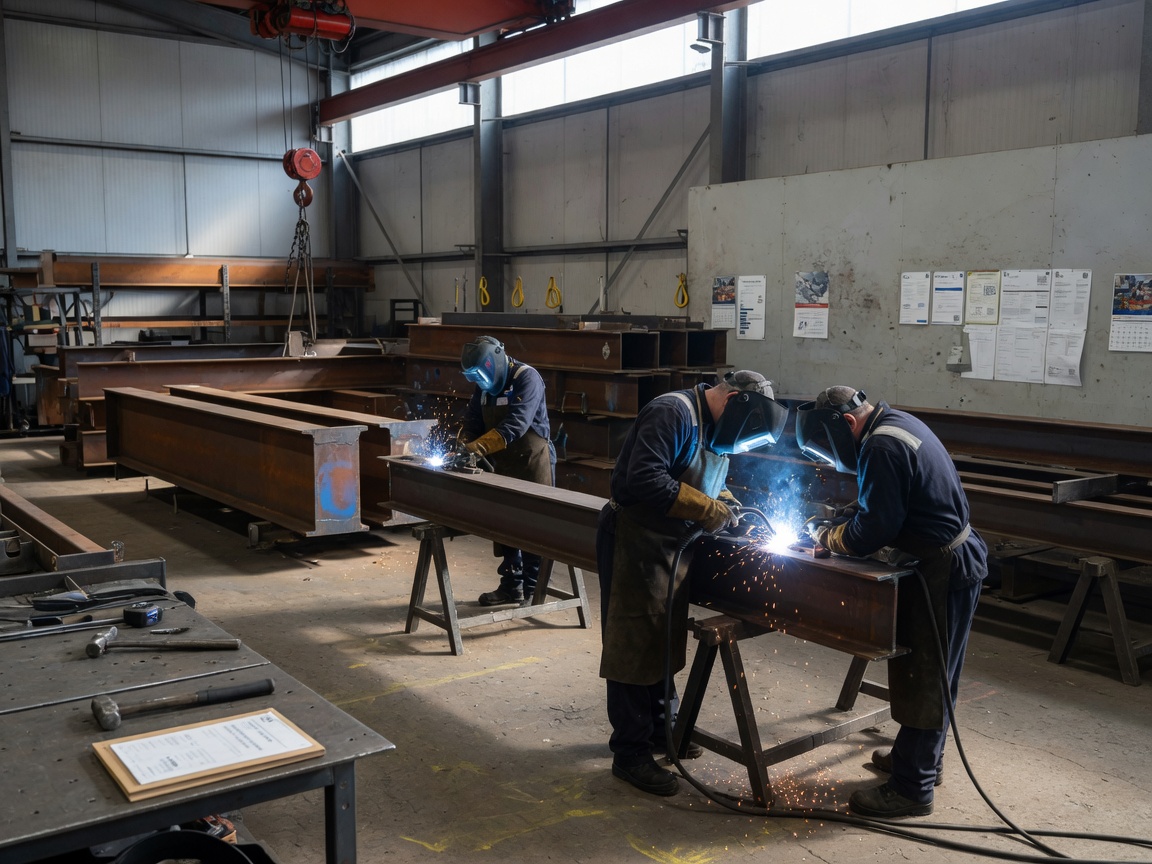
- ISO 3834 certification — This international standard for fusion welding quality management is increasingly expected on medium-to-high-risk projects. It provides independent assurance that the contractor's welding procedures, welder qualifications, and inspection regimes are in order.
- NHSS 20 (National Highways Sector Scheme) — Required for any steelwork on highway structures. Relevant if your project involves bridge parapets, gantries, or similar.
- ISO 9001 quality management — Whilst not steel-specific, it demonstrates a systematic approach to process control and non-conformance management.
- Safe Contractor or CHAS accreditation — Relevant for health and safety pre-qualification, particularly on principal contractor-managed sites.
A note on BCSA membership specifically
Not every competent steelwork fabrication and erection contractor holds BCSA membership — some smaller regional specialists operate perfectly well without it. However, for projects above approximately £500,000 in steelwork value, the absence of BCSA membership should prompt additional due diligence rather than automatic disqualification.
Checking credentials independently
Do not rely solely on a contractor's own marketing materials. The BCSA publishes a searchable online directory of members. ISO certification bodies issue certificates with unique registration numbers that can be verified directly with the certifying body. This takes less than ten minutes and is worth doing before committing to a tender shortlist.
UK cost benchmarks: what to budget in 2026
One of the most consistent complaints from procurement teams is that structural steelwork pricing feels opaque. It does not need to be. Based on 2026 market data from UK commercial and industrial projects, here are realistic benchmarks to inform early-stage budgeting.
| Cost element | Low range | Mid range | High range | Notes |
|---|---|---|---|---|
| Fabrication only (supply & fabricate) | £1,400/t | £1,750/t | £2,200/t | EXC2, standard sections, primer coat included |
| Erection only | £350/t | £500/t | £750/t | Varies significantly with site access and crane requirements |
| Fabricate + erect (combined) | £1,800/t | £2,200/t | £2,800/t | Most common UK procurement route for £500k+ packages |
| Architectural/exposed steelwork | £2,500/t | £3,500/t | £5,000+/t | Complex geometry, intumescent coating, EXC3 |
| Mezzanine floor (supply & install) | £60/m² | £90/m² | £130/m² | Particle board decking, handrails, standard loading |
These figures are indicative starting points, not fixed quotes. Actual tender returns will reflect current steel section prices (which fluctuate with global scrap and iron ore markets), local labour rates, programme constraints, and the complexity of the connection design. A portal frame warehouse in the East Midlands will attract keener pricing than an equivalent tonnage in Central London, purely on logistics and crane-hire grounds.
"Rework on structural steel — once members are fabricated — can cost 3–5× the original fabrication cost. Getting the scope and specification right before tender is not a bureaucratic exercise; it is the single most cost-effective investment a project team can make." — Industry guidance on structural steel procurement best practice
How to sense-check a tender return
If a tender return sits more than 20% below the mid-range benchmark, ask the contractor to break down their tonnage assumptions and programme duration. Under-pricing is rarely a gift — it is more often a sign of underestimated complexity, a thin prelims allowance, or a plan to recover margin through variations.
Steel vs concrete vs timber frame for UK commercial builds
Before appointing any steel frame builders, it is worth stress-testing whether steel is genuinely the right structural system for your project. The following comparison covers the most common scenarios encountered in UK commercial and industrial construction in 2026.
| Factor | Steel frame | Concrete frame (in-situ/precast) | Timber frame (CLT/glulam) |
|---|---|---|---|
| Span capability | Excellent — spans 40m+ easily | Good up to ~20m; longer spans costly | Moderate — typically up to 16m |
| Speed of erection | Fast — frame up in days | Slower — curing time adds weeks | Fast for prefabricated panels |
| Embodied carbon (kgCO₂e/t) | ~1,800 (virgin); ~600 (recycled EAF) | ~250 kgCO₂e/m³ (in-situ) | Negative (carbon sequestration) |
| Design flexibility | High — easy to modify post-construction | Low — structural walls hard to remove | Medium |
| Typical cost (structure only) | £80–£150/m² GIA | £90–£160/m² GIA | £120–£200/m² GIA |
| Best suited to | Warehouses, offices, retail, industrial | Multi-storey residential, car parks | Education, low-rise residential, offices seeking low-carbon narrative |
Steel dominates UK non-residential construction for a reason. Just as a suspension bridge cable is only as strong as its anchorage points, a steel frame's value is realised through the precision of its connections — and that precision is why experienced structural steel contractors with rigorous QA systems consistently outperform generalist builders on complex commercial projects. According to steel construction case studies published by the AISC, programme speed and adaptability consistently rank as the top two client-cited reasons for choosing steel over alternative structural systems.
When steel may not be the optimal choice
Steel's Achilles heel is embodied carbon — at least when virgin steel is specified. For projects where a developer has committed to a net-zero operational and embodied carbon target under UKGBC or RIBA 2030 Climate Challenge benchmarks, a hybrid concrete-steel or CLT-steel solution may achieve a better whole-life carbon score. This is worth discussing with your structural engineer before the structural steel tender is issued.
How to procure and tender structural steelwork in the UK
The procurement of structural steelwork in the UK follows a broadly consistent process whether the overarching contract is JCT Design and Build, NEC4 ECC, or a bespoke PFI/framework agreement. Here is the standard sequence for a mid-to-large commercial project.
- Define scope and specification: Produce a Structural Steelwork Specification aligned with BS EN 1090 execution class, fire protection strategy, and surface finish requirements. Include the steelwork design model in IFC/BIM format where available.
- Pre-qualification questionnaire (PQQ): Issue a PQQ to a long list of six to ten structural steelwork companies. Screen for execution class certification, financial standing, relevant project references, and H&S record.
- Tender list: Reduce to three or four contractors based on PQQ scores. Issue tender documentation including drawings, specification, schedule of quantities, and programme constraints.
- Tender period: Allow a minimum of four weeks for complex packages. Mid-tender queries should be managed through a formal RFI process and responses issued to all tenderers simultaneously to preserve fair competition.
- Tender analysis: Evaluate on a weighted scorecard covering price (~50–60%), programme (~15%), quality and technical approach (~15%), H&S (~10%), and sustainability credentials (~10%).
- Appointment and contract execution: Under JCT, the steelwork subcontractor is typically appointed on a DOM/1 or D&B subcontract. Under NEC4, Option A (priced contract with activity schedule) is most common for steelwork packages. Confirm all programme milestones, access dates, and information release schedule before signing.
- Pre-construction phase: Steelwork contractor produces shop drawings for engineer approval. Agree inspection and test plan (ITP), weld inspection regime, and delivery programme. This phase typically takes six to twelve weeks for a standard commercial scheme.
Key contract clauses to watch
Pay particular attention to the programme clause — specifically the contractor's right to extension of time if design information is released late. Steel fabricators commit fabrication capacity many weeks ahead. A late information release does not just delay the programme; it may mean losing your slot in the fabrication workshop entirely.
Common PAA: what does a structural steel contractor include in their scope?
Typically: structural steelwork supply and fabrication, erection, primary connections, holding-down bolts, and a primer paint coat. What is usually excluded: secondary steelwork (purlins, rails, liner trays), fire protection coatings, grouting of base plates, and architectural metalwork such as staircases or balustrades — unless explicitly stated otherwise in the scope of works.
Sustainability and net-zero credentials
Sustainability scrutiny of structural steel contractors has intensified sharply in the UK in 2026. Clients operating under BREEAM Outstanding targets, net-zero carbon commitments, or public-sector frameworks aligned with PAS 2080 (Carbon Management in Infrastructure) are now routinely asking contractors to demonstrate embodied carbon data, supply chain transparency, and recycled content percentages.
Here is what to look for:
- Recycled content and EAF steel: Electric arc furnace (EAF) steel uses up to 100% recycled scrap and produces approximately 600 kgCO₂e per tonne versus ~1,800 kgCO₂e for blast furnace virgin steel. UK-based structural steel contractors sourcing from domestic mills (such as British Steel or Celsa Steel UK) are already working with predominantly EAF-produced sections — a significant embodied carbon advantage built into the supply chain.
- Environmental Product Declarations (EPDs): Request project-specific or product-category EPDs for the steel sections to be used. This data feeds into whole-life carbon assessments and BREEAM Mat credits.
- BCSA Sustainability Charter: BCSA member companies are expected to report against the Charter's KPIs, covering carbon, waste, water, and workforce wellbeing.
- PAS 2080 alignment: For infrastructure-adjacent projects, ask whether the contractor can participate in carbon value engineering workshops under the PAS 2080 framework, identifying lower-carbon connection details or section choices without compromising structural performance.
"The UK steel industry's shift to EAF production represents one of the most significant embodied carbon reductions available within a standard commercial construction supply chain — without any premium in project cost." — 2026 data, BCSA sustainability reporting
BIM integration and prefabrication as sustainability tools
In 2026, BIM-integrated fabrication is no longer a differentiator — it is a baseline expectation on any project above 100 tonnes. The real sustainability dividend comes from the reduction in on-site waste and rework that accurate 3D modelling enables. Modular and prefabricated steel systems — where entire structural bays are assembled in a controlled workshop environment — are also gaining traction as a means of compressing programme duration and reducing carbon-intensive site activities.
Regional coverage and local considerations
When shortlisting steel construction companies UK, geography matters more than many procurement teams initially appreciate. A steelwork fabrication and erection contractor based in the West Midlands bidding on a project in Aberdeen will face significantly higher transport costs for fabricated sections, plus crane-hire and accommodation costs for erection gangs. These costs will either appear in the tender price or, if underestimated, manifest as programme pressure later.
UK regional concentrations of structural steelwork companies
The heaviest concentration of structural steel contractors in the UK is found in the Yorkshire and Humber region, the West Midlands, and the North West — reflecting the legacy of industrial manufacturing and proximity to steel mills. Scotland has a smaller but capable cluster of contractors serving the energy, offshore, and construction sectors. London and the South East tend to have fewer fabrication facilities but strong erection contractor capacity.
For London projects specifically, assess whether the contractor has experience managing deliveries under the London Lorry Control Scheme and working within congestion zone-adjacent sites — constraints that genuinely affect programme.
Common PAA: how far will a structural steel contractor travel?
Most UK fabricators will erect nationally, but their pricing becomes less competitive beyond approximately 150 miles from their fabrication facility. For projects in remote locations, it can be worth broadening the tender list to include contractors with a closer regional base, even if they are less well-known nationally.
Common mistakes when hiring steel contractors — and how to avoid them
Why do experienced project teams still get caught out when procuring structural steelwork? The honest answer is that steelwork packages are deceptively complex, and several recurring mistakes account for the majority of cost overruns and programme delays.
Selecting on price alone
The lowest tender return is not the lowest final account. Appointing on price without adequately assessing technical capability, fabrication capacity, and programme realism is a false economy. As noted earlier, rework on fabricated structural steel can cost three to five times the original fabrication value. The procurement evaluation should weight quality and technical approach meaningfully — not treat price as the only real criterion.
Confusing fabricator and erector capabilities
Not every steel fabricator UK is also an experienced erection contractor. Some excellent fabricators subcontract erection to specialist steel erection contractors — which is entirely acceptable, provided it is disclosed at tender stage and the erection subcontractor is pre-approved. Failing to clarify this results in unpleasant surprises regarding insurance, method statements, and on-site coordination.
Equally, do not assume that a portal frame contractor experienced in standard industrial sheds is automatically competent to handle the complexity of a multi-storey EXC3 commercial frame. Project reference checks should be like-for-like.
Common PAA: what questions should I ask a structural steel contractor before appointing?
Ask: What is your current BS EN 1090 execution class certification scope? Who certifies your welders and what NDT regime do you operate? What is your current fabrication programme — can you meet our required start on site date? Provide two references from comparable projects completed in the last 24 months. What is your policy on BIM and shop drawing coordination? These five questions will reveal more about a contractor's genuine capability than any brochure.
Also confirm compliance with steel erection safety standards, and ensure the contractor's method statement addresses fall protection, crane lift plans, and temporary stability during erection — areas where corners are sometimes cut under programme pressure.
Bringing it all together
Appointing the right structural steel contractors is one of the highest-leverage procurement decisions on any commercial or industrial build. A contractor with the right execution class certification, transparent pricing, credible sustainability data, and genuine regional capacity will de-risk your project in ways that cannot be recovered once fabrication has started. Use the accreditation checklist, cost benchmarks, and procurement sequence outlined in this guide as your evaluation framework — and resist the temptation to shortcut the pre-qualification process in the name of speed.
Frequently asked questions
Q: What is the difference between a steel fabricator and a steel erection contractor?
A: A steel fabricator manufactures structural steel members off-site in a workshop environment — cutting, drilling, and welding to engineered drawings. A steel erection contractor installs those fabricated members on site using cranes and specialist lifting equipment. Many structural steelwork companies offer both services under a single contract, which simplifies accountability and programme management.
Q: What BS EN 1090 execution class do I need for a standard UK commercial building?
A: Most UK commercial and industrial buildings — including offices, warehouses, retail units, and schools — fall under EXC2. This requires UKCA marking and third-party certified factory production control. EXC3 applies to higher-consequence structures such as hospitals and stadiums. Your structural engineer will confirm the required execution class in the project specification.
Q: How much does structural steelwork cost per tonne in the UK in 2026?
A: For a standard EXC2 fabricate-and-erect package, mid-range pricing in 2026 is approximately £2,200 per tonne. Fabrication alone typically ranges from £1,400 to £2,200 per tonne depending on complexity. Architectural or exposed steelwork can reach £3,500–£5,000 per tonne. These are indicative benchmarks — final tender prices depend on tonnage, programme, site conditions, and current steel section costs.
Q: Is BCSA membership essential when choosing a structural steel contractor?
A: BCSA membership is a strong quality and sustainability trust signal, but it is not a legal prerequisite. For projects above approximately £500,000 in steelwork value, absence of BCSA membership should prompt additional due diligence on the contractor's quality management systems, weld certification, and safety record rather than automatic disqualification.
Q: How long does the structural steelwork procurement process take?
A: Allow six to eight weeks for PQQ, tender, and evaluation on a mid-size commercial package. Add six to twelve weeks for the pre-construction phase — shop drawings, engineer approval, and fabrication programme confirmation — before steel arrives on site. Starting the procurement process late is one of the most common causes of programme delay on UK commercial construction projects.
TAG:
Latest News
Request a Quote
We will contact you within one working day. Please pay attention to your email.
正昌集团
010-65281358
No. 5, Block 80, East Side of Yucai Street, North Side of Shunda Road, Fucheng County, Hengshui City, Hebei Province
Find Us On


Get more information anytime


Copyright © 2026Rucheng Construction Group Co., Ltd
Powered by 300.cn | TAG | Privacy Policy