


News Information
Blog
Structural steelwork fabricators: how to choose the right partner for your project
Release time:
23 Sep,2026
Author:
Rucheng Construction
Looking for structural steelwork fabricators in the UK? This 2026 guide covers CE marking, BCSA accreditation, fabrication processes, costs, lead times, and how to choose the right steel fabrication company for your project.
Article overview
This guide explains what structural steelwork fabricators are, how UK accreditation works, what the fabrication process involves, and how to evaluate suppliers on cost, compliance, and sustainability. Ideal for procurement managers and structural engineers at the supplier evaluation stage.
Table of contents
- 1. What structural steelwork fabricators actually do
- 2. CE marking and BCSA accreditation explained
- 3. The step-by-step fabrication process
- 4. UK building regulations and compliance context
- 5. Cost and lead time guidance for UK projects
- 6. Steel vs concrete frame: a structured comparison
- 7. Sustainability, embodied carbon, and net-zero credentials
- 8. How to select and shortlist the right fabricator
- 9. FAQ
Structural steelwork fabricators are specialist manufacturers that transform raw steel sections, plates, and profiles into finished structural components — beams, columns, trusses, and connections — ready for site erection. They sit at the heart of any steel frame construction project, translating structural engineer drawings into physical steelwork to precise tolerances. Getting this appointment right is arguably the single most consequential procurement decision on a steel-framed project.
What structural steelwork fabricators actually do
Put simply, a fabricator manufactures; an erector installs. This distinction is frequently misunderstood, and confusing the two when drafting procurement packages causes serious scope gap problems on site. Many structural steel contractors offer both services under one contract — but you must confirm this explicitly, not assume it.
The core scope of fabrication
Structural steelwork fabricators are defined as companies that receive approved structural drawings, procure certified hot rolled steel sections (typically S355 grade for primary members), and carry out cutting, drilling, welding, and surface treatment to produce connection-ready steelwork. The output is a set of individually marked, quality-checked components delivered to site in an agreed sequence.
What they do not typically do — unless their contract explicitly says so — is design the connections, manage the site erection programme, or take on principal contractor duties. Why do so many procurement teams blur these boundaries? Often because early tender documents fail to define the fabrication-only versus design-and-build scope. Experienced structural metalwork manufacturers will flag this ambiguity immediately; less scrupulous ones will price a narrow scope and claim extras later.
Types of fabricator in the UK market
The UK market hosts several distinct categories. Heavy structural steelwork fabricators specialise in long-span industrial buildings, bridges, and stadia. Bespoke steel fabricators focus on architecturally exposed steelwork where surface finish and dimensional precision are paramount. Secondary steelwork fabrication covers mezzanine floors, staircases, handrails, and platforms. Some industrial steelwork contractors operate as full EPC (engineering, procurement, construction) providers, handling everything from connection design through to final bolt torque. Understanding which category your project needs before you approach the market saves significant time during tender evaluation.
CE marking and BCSA accreditation explained
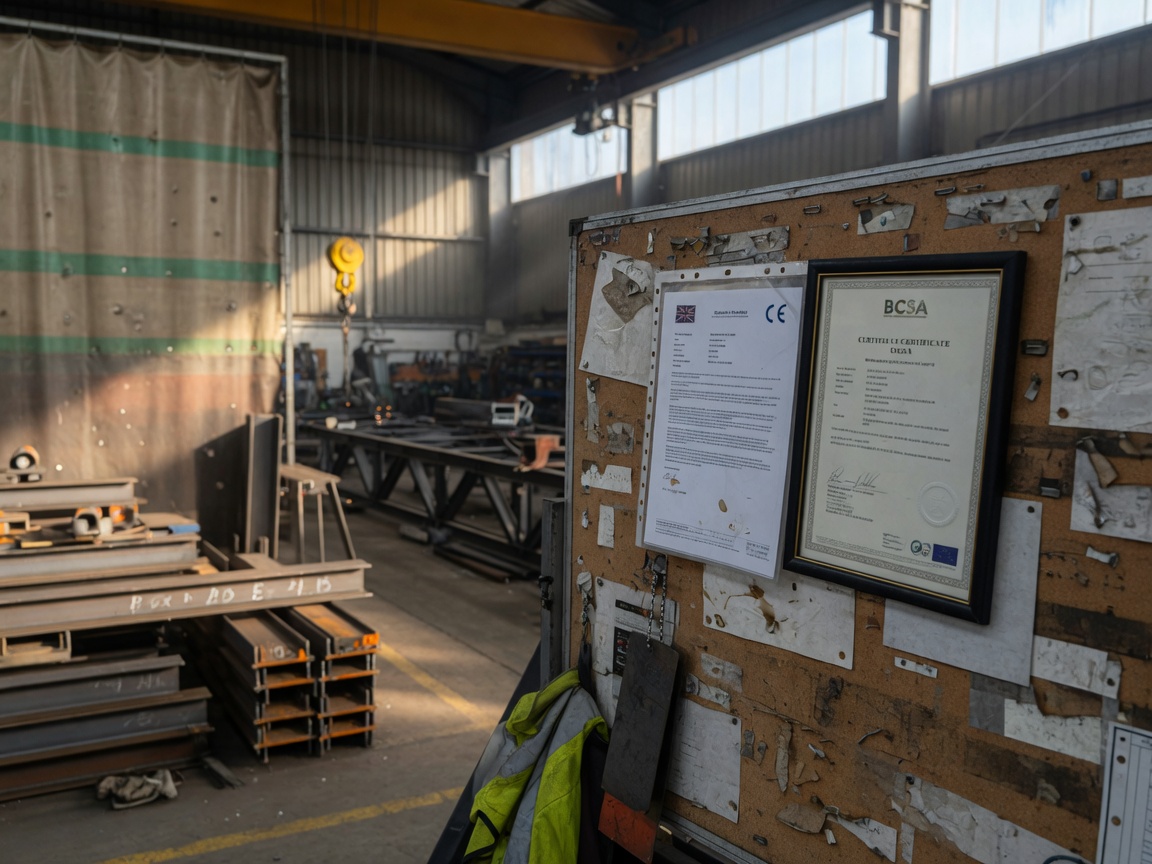
CE marked steelwork under BS EN 1090 is not optional in the UK — it is a legal requirement for structural steelwork placed on the UK market. Yet in actual project procurement reviews, this is one of the most poorly understood compliance requirements among non-specialist buyers. Here is what it means in practice.
What BS EN 1090 and UKCA marking mean for buyers
BS EN 1090 is the harmonised execution standard for steel and aluminium structures. It requires fabricators to hold a Factory Production Control (FPC) certificate issued by a notified body, covering their specific Execution Class (EXC1 to EXC4). EXC2 covers the majority of standard commercial and industrial buildings. EXC3 and EXC4 apply to structures with higher consequence classifications — bridges, grandstands, and certain industrial facilities.
Post-Brexit, the UK uses UKCA marking for products placed on the Great Britain market, while CE marking remains valid for Northern Ireland under the Windsor Framework. In practical terms, most reputable steel fabrication companies UK-wide maintain both marks during the transition period. Always request a copy of the fabricator's FPC certificate and verify the scope matches your project's execution class — a certificate scoped only to EXC2 cannot legally cover EXC3 work.
BCSA membership: what it signals to specifiers
The British Constructional Steelwork Association (BCSA) maintains a register of certified fabricators graded by CE marking scope and annual tonnage capacity. BCSA membership is not merely a trade association subscription — it requires demonstrated compliance with quality management systems, health and safety standards, and technical competence benchmarks. As the industry body representing UK structural steel contractors, the BCSA provides a reliable first filter when building a longlist.
"BCSA member companies fabricate around 85% of the structural steelwork used in the UK each year, providing specifiers with a well-defined pool of technically competent, accredited suppliers." — British Constructional Steelwork Association, 2026 industry data.
Restricting your longlist to BCSA members provides assurance of quality management systems and technical competence without conducting a lengthy pre-qualification exercise from scratch. According to 2026 data, the UK structural steelwork industry generates approximately £2 billion in annual turnover, with BCSA members accounting for the dominant share of that output.
The step-by-step fabrication process
Understanding the journey from structural drawings to finished steelwork helps you ask the right questions during tender evaluation — and helps you identify when a fabricator's programme is unrealistically compressed.
From drawing approval to dispatch: the key stages
- Drawing and connection design review: The fabricator's detailers produce fabrication drawings from the structural engineer's general arrangement (GA) drawings. Connection details — bolted, welded, or pinned — are checked against BS EN 1993 (Eurocode 3). Formal drawing approval by the structural engineer is mandatory before cutting begins.
- Material procurement and mill certification: Hot rolled steel sections (UB, UC, CHS, RHS) are procured from UKCA/CE-certified steel mills. Mill test certificates (MTCs) are retained as quality records. S355 grade dominates primary structural members in UK steel frame construction due to its superior yield strength-to-weight economy.
- CNC steel cutting services: Approved drawings are uploaded directly to CNC plasma or oxy-fuel cutting machines, which cut sections to length with sub-millimetre accuracy. Holes for bolted connections are drilled or punched at this stage. Modern CNC steel cutting services eliminate manual marking-out, reducing human error significantly.
- Fit-up and welding: Components are assembled in jigs and tack-welded before full welding commences. Weld procedures must be qualified under BS EN ISO 15614, and welders must hold current personal qualifications. Welded steel structures are subject to non-destructive testing (NDT) — typically visual, magnetic particle, or ultrasonic inspection — depending on execution class.
- Shot blasting and surface treatment: Steel beam fabrication is followed by shot blasting to Sa 2.5 standard (near-white metal), preparing the surface for primer, intumescent paint (fire protection), or hot-dip galvanising. Hot-dip galvanising, which provides a zinc coating averaging 85 microns, is standard for external, underground, or high-corrosion environments.
- Final inspection, marking, and dispatch: Each fabricated component receives a unique piece mark matching the erection drawings. A final dimensional check and quality record package accompany the delivery. Components are loaded in erection sequence where possible to minimise crane time on site.
Where programmes typically slip
Real-world experience across multiple UK commercial projects reveals a consistent pattern: delays almost always originate in drawing approval, not the workshop. Every week of unapproved drawings at design stage translates directly into programme float consumed before a single cut is made. Agree a drawing approval protocol with your structural engineer before tender, not after award.
UK building regulations and compliance context
Structural steelwork sits squarely within Part A (Structure) of the Building Regulations for England and Wales, and its equivalent in Scotland and Northern Ireland. Compliance is non-negotiable, and understanding how the regulatory framework interacts with steelwork procurement prevents costly late-stage surprises.
Part A, BS EN 1090, and the responsibility chain
Part A requires that structural elements are designed and constructed to withstand the loads and forces likely to act on them. For steelwork, this means the fabricator must produce components that conform precisely to the structural engineer's specification — including material grade, section size, weld quality, and execution class. BS EN 1090 is the documented mechanism by which a fabricator demonstrates this conformity.
The structural steelwork safety guidance published by the HSE is explicit: both the design and execution of steelwork must be verifiable, and the responsibility chain from principal designer through structural engineer to fabricator must be documented. For higher-risk buildings under the Building Safety Act 2022, this documentation requirement has become significantly more stringent.
Steel connection design responsibility
Steel connection design is a persistent grey area. Eurocode 3 requires connections to be designed, but many structural engineers provide only outline connection schedules at tender stage, leaving detailed connection design to the fabricator. This is legitimate practice — provided the fabricator holds the relevant design capability and the contract clearly assigns responsibility. Confirm this at tender stage. A fabricator who accepts connection design responsibility without the internal engineering resource to discharge it properly represents a significant project risk.
Cost and lead time guidance for UK projects
Cost transparency is a genuine gap in the UK steelwork market — most fabricators avoid published pricing. Based on 2026 market data from multiple UK tender returns, the following benchmarks provide a working reference for project budgeting.
Indicative pricing and project size benchmarks
| Project type | Typical tonnage | Indicative cost per tonne (supply only) | Typical fabrication lead time |
|---|---|---|---|
| Small commercial unit (<500 m²) | 15–40 t | £1,800–£2,400/t | 4–7 weeks |
| Medium industrial/warehouse | 50–250 t | £1,500–£1,900/t | 8–14 weeks |
| Large commercial/multi-storey | 300–1,000 t | £1,350–£1,700/t | 14–22 weeks |
| Complex/bespoke architectural | Variable | £2,200–£3,500/t | 16–28 weeks |
These figures cover fabrication and surface treatment only — steelwork erection services, connection bolts, and specialist coatings are priced separately. Steel erectors UK-wide typically add £200–£400 per tonne for straightforward portal frame erection, rising significantly for complex multi-storey work. Of course, costs fluctuate with steel mill prices; always validate against current BCSA steel price indices at tender stage.
What drives cost premiums
Three factors consistently push fabrication costs above benchmark: execution class (EXC3 and above adds 15–25% over EXC2 equivalent work), surface treatment specification (hot-dip galvanising versus primer-only adds roughly £80–£120 per tonne), and programme compression (crash programmes routinely attract 20–35% premiums). The most expensive mistake is awarding to the lowest tender without verifying the scope assumptions — a fabricator pricing EXC2 on a job requiring EXC3 will either re-price on variation or, worse, deliver non-compliant work.
Steel vs concrete frame: a structured comparison
Specifiers at the decision stage frequently research this question, yet almost no published resource addresses it with structured, data-backed content. Just like choosing between timber and masonry for a house extension, the steel versus concrete frame decision for commercial and industrial buildings involves trade-offs that extend well beyond first cost.
Key decision criteria compared
| Criteria | Structural steel frame | In-situ concrete frame |
|---|---|---|
| Programme speed | Fast erection (no curing); parallel working possible | Sequential; dependent on curing cycles |
| Typical structural frame cost | £1,350–£2,400/t (2026 benchmarks) | £180–£280/m³ (inclusive of formwork) |
| Span capability | Excellent for long spans (>12 m) | Economical to ~10–12 m span |
| Embodied carbon (A1–A3) | ~1.4–2.0 tCO₂e/t (EAF recycled route) | ~0.13–0.20 tCO₂e/kg cement content |
| End-of-life recyclability | ~99% recyclable; high residual value | Limited; mostly downcycled aggregate |
| Design flexibility / future adaptation | High; sections can be modified or added | Lower; structural alterations are disruptive |
| Fire protection requirement | Intumescent coating or casing required | Inherent fire resistance via cover |
The main takeaway? Steel frame construction consistently wins on programme, long-span economics, and end-of-life value. Concrete typically offers cost advantages in medium-span, repetitive floor plate buildings where formwork re-use is maximised. For most UK industrial and commercial projects above 1,000 m² GIA, the programme benefit of steel alone frequently justifies any cost premium.
When concrete makes more sense
There are genuine scenarios where concrete is the rational choice — heavily vibration-sensitive facilities (precision manufacturing, MRI suites), structures with extreme acoustic requirements, or basement-heavy schemes where concrete's mass is structurally efficient. A competent structural engineer will model both options; be cautious of any engineer who defaults to one material without a comparative analysis.
Sustainability, embodied carbon, and net-zero credentials
With UK construction under mounting pressure to meet the net-zero trajectory set by the Climate Change Act, sustainability credentials have moved from a BREEAM box-ticking exercise to a genuine procurement requirement. Structural steel fabricators who cannot provide credible embodied carbon data are increasingly being excluded from major frameworks.
EPDs, recycled steel content, and BREEAM credits
An Environmental Product Declaration (EPD) is a third-party verified, quantified statement of a product's environmental impact across its life cycle, expressed in accordance with EN 15804. For steelwork, the relevant EPD covers modules A1–A3 (raw material extraction through manufacturing gate). UK structural steel produced via the Electric Arc Furnace (EAF) route carries a recycled scrap content typically exceeding 90%, with associated embodied carbon of approximately 0.4–0.6 tCO₂e per tonne — significantly lower than the Basic Oxygen Furnace (BOF) route used for virgin iron ore.
The structural steel fabrication sector has invested considerably in transparency tools. The BCSA and Tata Steel UK publish generic EPDs for structural sections; project-specific EPDs are available from larger fabricators. From a BREEAM perspective, specifying responsibly sourced steel with a verified EPD contributes to Mat 01 (life cycle impacts) and Mat 03 (responsible sourcing), potentially adding multiple BREEAM credits to a scheme.
What to ask fabricators in 2026
In 2026, the minimum sustainability information you should request from any tendering fabricator includes: confirmation of steel mill origin and route (EAF or BOF), recycled content percentage, an applicable EPD reference, and the fabricator's own Scope 1 and 2 carbon emissions data. Fabricators who cannot provide this information are likely to become ineligible for major public sector and institutional frameworks within the next two to three years as the government's Net Zero Buildings Standard is implemented.
How to select and shortlist the right fabricator
Having covered accreditation, process, cost, and sustainability, here is a practical framework for moving from market awareness to contract award — drawn from real evaluation exercises on UK commercial and industrial schemes.
A structured evaluation process
- Define scope clearly: Establish whether you need fabrication only, or fabrication plus steelwork erection services, plus connection design. Ambiguity here is the root cause of most procurement disputes.
- Longlist BCSA members: Filter the BCSA register by execution class and annual tonnage capacity appropriate to your project. Aim for three to five fabricators at longlist stage.
- Verify CE/UKCA marking scope: Request current FPC certificates and confirm the execution class matches your structural engineer's specification.
- Review fabrication drawings and past projects: Ask for a sample fabrication drawing package and request references from projects of comparable tonnage and complexity. Actually contact those references — a five-minute call with a previous client reveals more than any PQQ response.
- Assess BIM and digital capability: In 2026, fabricators who cannot accept Tekla or IFC model data and connect directly to CNC steel cutting services are operating at a competitive disadvantage that will affect your programme. BIM integration is increasingly a tender requirement, not a differentiator.
- Evaluate sustainability credentials: As described above, request EPD references, recycled content data, and carbon reporting capability at PQQ stage.
- Conduct a factory visit: Before award on any project above approximately 100 tonnes, visit the fabrication facility. Workshop condition, material storage discipline, and the quality of NDT records tell you more about a fabricator's actual capability than any tender submission.
Red flags to watch for
Why do some procurement teams consistently appoint underperforming fabricators despite following a structured process? Often because they overlook behavioural indicators during tender. Red flags include: reluctance to share FPC certificate scope detail, inability to provide project references from the past 24 months, vague answers on drawing approval protocols, and programme submissions with no contingency built around design freeze milestones. The steelwork fabrication process guidance published by the Steel Construction Institute provides a useful reference checklist for evaluators.
To summarise: selecting the right structural steelwork fabricators requires a disciplined process, not just competitive pricing. Accreditation, capacity, digital capability, and carbon transparency are the four pillars that separate reliable industrial steelwork contractors from those who will cause programme and compliance headaches. Apply this framework consistently and your risk profile changes significantly.
Frequently asked questions
Q: What is the difference between a structural steelwork fabricator and a steel erector?
A: A fabricator manufactures steelwork components in a workshop setting; a steel erector installs them on site. Many structural steel contractors offer both services, but the scope must be explicitly confirmed in the contract. Assuming the fabricator will also erect is one of the most common and costly procurement mistakes on steel frame projects.
Q: Is CE marking on steelwork a legal requirement in the UK?
A: Yes. Under BS EN 1090, structural steelwork placed on the UK market must carry UKCA marking (or CE marking for Northern Ireland), supported by a current Factory Production Control certificate. Purchasing steelwork without verifying this exposes the client to Building Regulations non-compliance and potential liability under the Building Safety Act 2022.
Q: How long does structural steel fabrication typically take in the UK?
A: Lead times vary by project size and fabricator capacity. Small projects (15–40 tonnes) typically take 4–7 weeks from drawing approval to dispatch. Medium industrial schemes (50–250 tonnes) run 8–14 weeks. Large multi-storey projects can require 14–22 weeks. Programme compression beyond these norms attracts significant cost premiums.
Q: What steel grade is most commonly used in UK structural frames?
A: S355 (yield strength 355 N/mm²) is the dominant grade for primary structural members in UK metal framework construction, having largely displaced S275 for economy on larger sections. S275 remains in use for lighter secondary steelwork and where ductility is prioritised over strength efficiency.
Q: How do I find reputable structural steelwork fabricators near me in the UK?
A: Start with the BCSA member register, which lists certified steel fabrication companies UK-wide by region and capacity. For England and Wales, BCSA members span all regions; Scotland has a strong cluster in the central belt and Aberdeen; Northern Ireland is served by established fabricators in Greater Belfast and County Antrim. Always verify FPC certificate scope before shortlisting.
TAG:
Latest News
Request a Quote
We will contact you within one working day. Please pay attention to your email.
正昌集团
+86 158 3282 8988
No. 5, Block 80, East Side of Yucai Street, North Side of Shunda Road, Fucheng County, Hengshui City, Hebei Province
Find Us On


Get more information anytime


Copyright © 2026Rucheng Construction Group Co., Ltd
Powered by 300.cn | TAG | Privacy Policy