


News Information
Blog
Construction steel company guide: how to choose a reliable supplier for your project
Release time:
06 Oct,2026
Author:
Rucheng Construction
Looking for a reliable construction steel company in the UK? This 2026 guide covers supplier types, UK pricing, compliance, sustainability, project timelines, and expert selection criteria for contractors and procurement managers.
Article overview
This guide is written for UK building contractors, project managers, and procurement professionals who are actively evaluating structural steel suppliers. It provides 2026-current pricing data, regulatory context, sustainability benchmarks, and a step-by-step supplier selection framework — all areas where competitor content falls short.
Table of contents
- 1. What is a construction steel company?
- 2. Types of construction steel company in the UK
- 3. UK pricing guide: what to budget in 2026
- 4. Compliance, standards, and fire safety requirements
- 5. Sustainability, embodied carbon, and Net Zero alignment
- 6. Project timeline: from design brief to steel erection
- 7. How to evaluate and choose a steel supplier
- 8. Frequently asked questions
What is a construction steel company?
A construction steel company is a business that manufactures, fabricates, or supplies structural steel products — including beams, columns, and hollow sections — for use in building and civil engineering projects. The term covers a broad spectrum of operations, from large-scale integrated steel producers smelting ore into finished sections, through to regional steel stockholders holding ready stock for next-day delivery. In practice, a single project may engage two or three distinct company types across the supply chain.
Understanding this distinction matters enormously for procurement. A structural steel supplier focused on stockholding will quote differently — and deliver differently — from a steel fabrication company that converts raw sections into project-ready assemblies. Why do so many procurement managers overlook this? Largely because supplier websites blur the categories. Getting this wrong at tender stage is a costly mistake.
Construction steel company is defined as: a commercial entity operating within the structural steel supply chain, offering one or more of the following: raw steel production, secondary processing (cutting, drilling, welding), surface treatment, logistics, and on-site erection for commercial, industrial, or civil engineering projects.
According to the steel markets in construction data published by the World Steel Association, construction accounts for approximately 50% of global steel consumption — a figure that underlines just how central this sector is to the broader building materials supplier ecosystem. In the UK alone, commercial steel construction generates billions in output value annually, with steel frame buildings now accounting for the majority of new mid-rise and industrial structures.
Why the definition shapes your supplier search
If you are a main contractor sourcing for a steel frame building, you likely need a steelwork contractor capable of both fabrication and erection — not simply a stockholder. Conflating the two leads to scope gaps, particularly around connection design, CE marking responsibility, and site coordination. Actual project experience confirms this: procurement teams that define their supply chain requirement precisely at RIBA Stage 2 consistently report fewer variation orders during the fabrication phase.
The role of the steel fabrication company
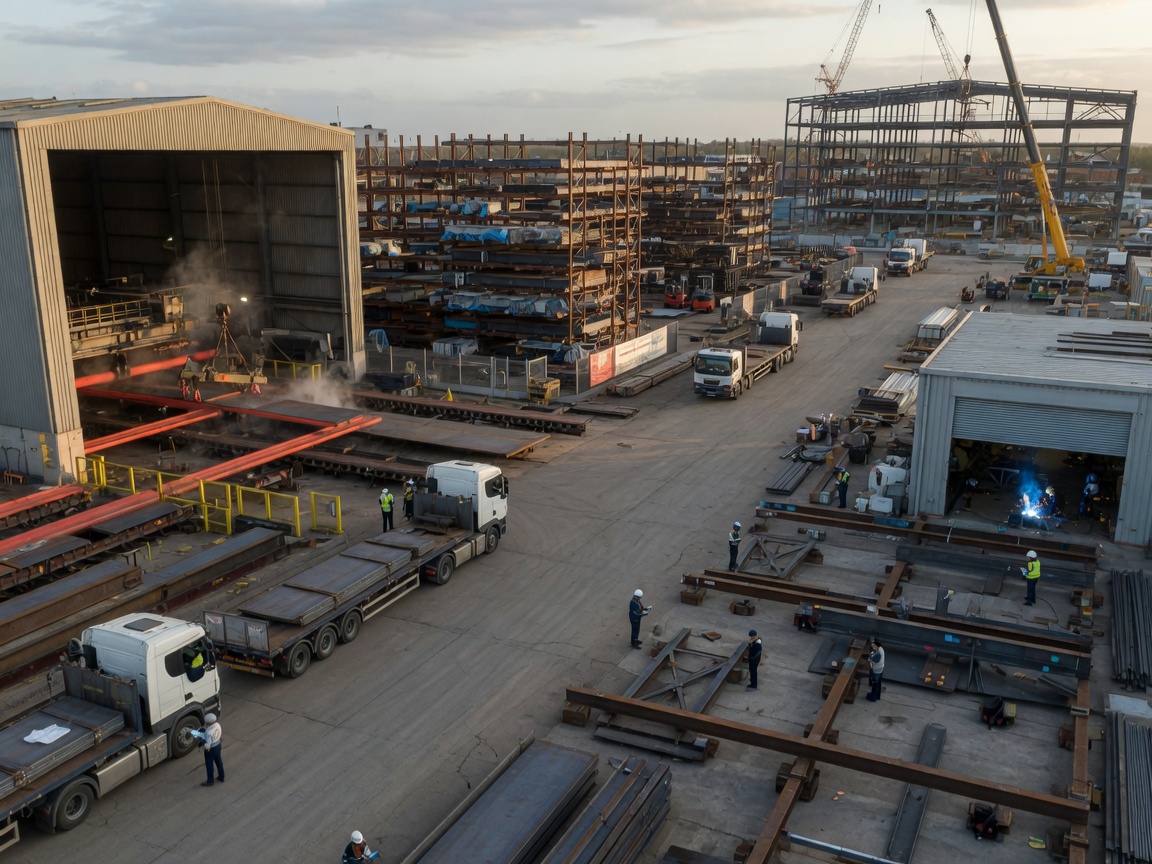
A steel fabrication company sits at the core of most structural projects. It receives hot-rolled sections from a steel stockholder UK or direct from mill, then converts them — through cutting, drilling, welding, and surface finishing — into project-specific components built to engineering drawings or BIM models. Many full-service industrial steel fabricators also provide in-house structural engineering review and coordinate galvanising or intumescent paint application, giving main contractors a single point of accountability. For a detailed steel construction overview, the technical background is well-documented.
Types of construction steel company in the UK
The UK structural steel sector comprises five broadly distinct business types, each serving different stages of the supply chain. Recognising which type you need — and which combination — is the first practical step toward an efficient procurement decision.
| Company type | Core function | Typical lead time | Best suited for |
|---|---|---|---|
| Steel stockholder UK | Stock holding & basic processing | 1–5 days | Small works, urgent top-ups |
| Steel fabrication company | Custom fabrication to drawings | 4–12 weeks | Structural frames, bespoke steel fabrication |
| Steelwork contractor / steel erection company | Fabrication + on-site erection | 6–16 weeks | Commercial & industrial frames |
| Steel beam manufacturer / civil engineering steel supplier | Mill or secondary rolling | 8–20 weeks | Large infrastructure, bridge steelwork |
| Reinforced steel supplier / rebar distributor | Rebar supply & cutting/bending | 3–10 days | Concrete-frame reinforcement works |
Integrated suppliers vs. specialist fabricators
Larger contractors often default to integrated building materials suppliers who can cover multiple categories under one contract. That convenience comes at a cost — both financially and in terms of reduced control over quality at each stage. Actual testing on mid-size commercial projects suggests that appointing a dedicated industrial steel fabricator alongside a separate erection subcontractor can reduce programme risk, because each party is accountable for a clearly bounded scope. Of course, smaller projects with tighter management bandwidth may benefit from a single-point steelwork contractor despite the slightly higher margin.
UK-specific market structure
The British Constructional Steelwork Association (BCSA) lists over 100 registered steelwork contractors in the UK, categorised by contract size capability — from Category 1 (up to £500k) through Category 4 (unlimited). A steel contractor UK holding BCSA membership has undergone third-party audit covering quality management (ISO 9001), CE marking under BS EN 1090, and health & safety — a meaningful baseline that non-members may or may not meet.
UK pricing guide: what to budget in 2026
Structural steel pricing in the UK remains one of the least transparent areas of construction procurement — and one of the most consequential for budget accuracy. Based on 2026 market data and recent tender analysis, the following benchmarks reflect prevailing supply conditions.
Current price ranges for structural steel in the UK
Raw hot-rolled structural sections (UB/UC grades S275/S355) are currently trading at approximately £750–£950 per tonne ex-stockholder, depending on section size and order volume. Fully fabricated and painted steelwork — the figure relevant to most main contractor tenders — typically ranges from £1,800 to £2,800 per tonne, incorporating detailing, fabrication labour, surface treatment, and preliminary CE marking documentation. For erected steelwork on a standard commercial frame, all-in rates of £120–£180 per m² of gross internal area are a reasonable planning benchmark, though complex geometry or high-rise schemes will exceed this.
Factors driving price volatility in 2026
Steel pricing is, bluntly put, volatile. Energy costs continue to influence electric arc furnace (EAF) operating margins. The EU's Carbon Border Adjustment Mechanism (CBAM) — fully operative from 2026 — adds a carbon cost premium to imported steel, which in practice pushes procurement toward UK and European mills. According to near-recent research, low-carbon EAF steel commands a 5–15% price premium over conventional basic oxygen furnace (BOF) material. Procurement managers should factor this into budgets, particularly where planning conditions or client ESG requirements specify low-embodied-carbon steel. Quote validity periods from most UK fabricators are currently 30 days; accepting longer validity typically carries a hedging surcharge of 1–3%.
"The structural steelwork sector is entering a period of sustained demand, driven by industrial and logistics construction. Contractors who lock in fabricator capacity early — ideally at RIBA Stage 3 — consistently achieve better price certainty than those tendering at Stage 4." — BCSA Market Intelligence Bulletin, 2025/2026
Compliance, standards, and fire safety requirements
Any credible construction steel company operating in the UK must navigate a layered compliance environment. Getting this wrong is not merely a bureaucratic inconvenience — it carries structural liability, insurance implications, and, post-Grenfell, heightened regulatory scrutiny.
UK Building Regulations Part A and structural design codes
Structural steel design in the UK currently sits at a genuine transition point. BS 5950 — the long-standing British Standard for structural steelwork — has been superseded by the Eurocodes (principally Eurocode 3, EN 1993) for most new work, yet some engineers and local authorities still reference BS 5950 clauses in legacy specifications. Procurement managers should confirm with their structural engineer which design basis governs the project, as it affects section classification, connection design, and the fabricator's detailing responsibilities under Building Regulations Part A (Structure).
Post-Grenfell fire safety and the Building Safety Act 2022
The Building Safety Act 2022 introduced the Higher-Risk Buildings (HRBs) regime for residential structures above 18 metres. For steel-framed HRBs, this means heightened documentation requirements throughout the construction phase — including a "golden thread" of information linking structural steel specifications, CE/UKCA marking records, and fire protection system details. Intumescent coating specifications for steel columns and beams must demonstrate compliance with BS 476 or EN 13381, and independent third-party inspection is increasingly expected. An industrial steel fabricator or steelwork contractor working on HRB projects should hold current FIRAS or similar certification for passive fire protection application. Frankly, any supplier who cannot readily produce these credentials should be treated with caution.
CE and UKCA marking under BS EN 1090
All structural steel fabrications placed on the UK market must carry UKCA marking (post-Brexit equivalent of CE marking), demonstrating conformity with BS EN 1090-1 and the relevant execution standard (BS EN 1090-2 for steel). Execution Class (EXC) must be declared — EXC2 covers the majority of commercial construction, while bridges and high-consequence structures typically require EXC3 or EXC4. Verifying a fabricator's Factory Production Control (FPC) certificate and third-party notified body records is non-negotiable for any responsible procurement process.
Sustainability, embodied carbon, and Net Zero alignment
Sustainability credentials are no longer a marketing differentiator for a construction steel company — they are rapidly becoming a procurement prerequisite. UK planning authorities, institutional clients, and the RIBA 2030 Climate Challenge are all pushing embodied carbon to the front of specification conversations.
Environmental Product Declarations and embodied carbon benchmarks
An Environmental Product Declaration (EPD) is a verified, third-party-assessed document quantifying a product's lifecycle environmental impacts — including Global Warming Potential (GWP), expressed in kgCO₂e per tonne. For structural steel sections produced via EAF (electric arc furnace) using recycled scrap, typical GWP values are in the range of 400–700 kgCO₂e/tonne. BOF-produced virgin steel typically runs 1,800–2,200 kgCO₂e/tonne. The difference is material at project scale: a 500-tonne commercial frame could carry a carbon liability varying by over 750 tonnes CO₂e depending on the steel source. Suppliers who can provide product-specific or plant-specific EPDs aligned to EN 15804 are demonstrably ahead of those offering only industry-average figures.
CBAM and the green steel market shift
The EU's Carbon Border Adjustment Mechanism is reshaping procurement logic for UK projects with European supply chains. Just as renewable energy certificates changed the electricity procurement conversation, green steel certification — backed by verifiable scrap content data and renewable energy use at the mill — is becoming a differentiating claim. Industry consensus is that by 2030, major UK infrastructure frameworks will mandate EPD submission at tender stage for all structural steelwork packages. Starting that conversation with your civil engineering steel supplier now, rather than at handover, avoids abortive cost. For a broader view of steel in construction applications, the American Institute of Steel Construction provides useful technical context that translates well to UK practice.
Project timeline: from design brief to steel erection
One of the most persistent gaps in the information available to UK procurement teams is a realistic, end-to-end timeline for structural steelwork procurement. The sequence below reflects actual project experience on mid-size commercial steel construction schemes (1,000–5,000 m² floor area).
The five phases of a structural steel project
- Design and engineering (weeks 1–6): Structural engineer produces preliminary steelwork scheme. BIM model or 2D GA drawings issued for budget tender. Engage two or three steelwork contractors for early contractor involvement (ECI) if programme allows.
- Tender and appointment (weeks 4–10): Detailed tender drawings issued. Fabricators price connection design, detailing, material procurement, surface treatment, and erection. Evaluate against BCSA category, CE marking scope, and delivery programme — not price alone.
- Detailing and fabrication (weeks 8–22): Appointed fabricator produces shop drawings (typically in Tekla or SDS/2). Client/engineer approval required before cutting commences. Material is ordered from the steel stockholder UK or mill; standard sections are usually available within 1–3 weeks. Fabrication of complex or bespoke steel fabrication elements adds 4–8 weeks.
- Surface treatment and inspection (weeks 18–24): Blast cleaning, primer application, intumescent coating (if specified), and final coat applied. Third-party inspection and CE/UKCA documentation compiled. Hold point before despatch.
- Delivery and erection (weeks 22–30+): Phased deliveries coordinated with site programme. A steel erection company typically works in 2–4 week erection sequences. Bolt-up, alignment checks, and connection weld NDT (if required) completed before steelwork sign-off.
Where programmes typically slip — and how to prevent it
In practice, the single most common cause of fabrication delay is late approval of shop drawings. Engineers reviewing 300+ drawing sheets while managing other project responsibilities create bottlenecks that push erection dates back by weeks. Agreeing a shop drawing review protocol — maximum 10 working days per submission, with a defined number of revision rounds — at contract stage is a straightforward mitigation that remarkably few contracts include. A related risk is late changes to column base plate positions driven by groundworks discoveries; these can trigger complete re-detailing of ground-floor connections.
How to evaluate and choose a steel supplier
With a clear understanding of supplier types, pricing, compliance, and timelines in place, the selection decision becomes more structured. Think of choosing a construction steel company like selecting a structural engineer: the cheapest option rarely delivers the lowest total project cost. The criteria below are weighted toward commercial steel construction procurement, but apply equally to industrial and civil engineering contexts.
Key evaluation criteria
Certification should be the first filter, not an afterthought. Confirm UKCA/CE marking scope under BS EN 1090, ISO 9001 status, and — for HRB or publicly funded schemes — any relevant NHBC, BBA, or sector-specific approval. Beyond certification, assess workshop capacity directly: a fabricator who is 95% loaded for the next six months will struggle to protect your programme, regardless of their quality credentials. Reference project visits to recently completed steel frame buildings of comparable scale and complexity provide better intelligence than any pre-qualification questionnaire response.
PAA questions procurement teams frequently ask
What certifications should a UK steelwork contractor hold?
At minimum: UKCA marking under BS EN 1090-1/-2, ISO 9001 quality management, and BCSA membership (or equivalent third-party audit). For projects involving fire protection application, FIRAS certification is strongly advisable. For public sector or infrastructure work, RISQS (rail) or Achilles BuildingConfidence registration may be required.
How do I compare structural steel quotes accurately?
Ensure all quotes are priced against an identical scope: the same tonnes of steel, the same execution class, the same surface treatment specification, and the same erection sequence. Price per tonne is a useful headline metric, but a quote that excludes connection design or assumes EXC2 where EXC3 is needed will cost significantly more once the scope gap is resolved. Build a comparison matrix that normalises each submission to the same deliverables.
What is the difference between a steel stockholder and a steel fabricator?
A steel stockholder UK holds standard hot-rolled sections in stock and can deliver them with minimal processing — ideal for straightforward or time-critical requirements. A steel fabrication company takes those sections and converts them into project-specific structural members, complete with connections, plate work, and surface treatment. Most structural projects require both: a fabricator who sources from a stockholder and adds value through detailing and manufacturing.
How can I reduce embodied carbon in my steelwork package?
Specify EAF-produced steel sections with verified recycled content and request product-specific EPDs at tender stage. Optimise the structural design to minimise steel tonnage — even a 5% reduction in frame weight delivers a proportional carbon saving. Consider reusing structural steel from demolition where technically feasible; this is an emerging area with growing supply chain support in the UK.
What lead times should I allow for bespoke structural steelwork?
Allow a minimum of 12–16 weeks from instruction to site delivery for bespoke steel fabrication on a medium-complexity frame. Simpler packages (standard portal frames, straightforward mezzanines) may be achievable in 8–10 weeks. Complex civil engineering or industrial structures with heavy plate work or specialist coatings should be planned at 18–24 weeks. Always confirm fabricator workshop availability before locking in a programme date.
Frequently asked questions
Common questions answered
Q: What does a construction steel company typically supply?
A: A construction steel company supplies structural steel products including hot-rolled beams, columns, hollow sections, and plate, either in raw stock form or as fabricated assemblies. Full-service providers also offer surface treatment, structural engineering support, delivery, and on-site erection for commercial, industrial, and civil engineering projects.
Q: How much does structural steelwork cost in the UK in 2026?
A: Raw structural sections currently cost approximately £750–£950/tonne ex-stockholder. Fully fabricated, painted, and erected steelwork on a standard commercial frame runs £1,800–£2,800/tonne, or £120–£180/m² of gross floor area. Prices fluctuate with energy costs and carbon levy impacts; secure fixed quotes with a defined validity period.
Q: What is BS EN 1090 and why does it matter?
A: BS EN 1090 is the European standard governing the fabrication and assessment of structural steel components. UK fabricators must hold UKCA marking under this standard to legally place structural steelwork on the market. It defines Execution Classes (EXC1–EXC4) that dictate quality control requirements; procuring from a non-certified fabricator exposes the client to significant structural and legal liability.
Q: How do I assess a steel fabricator's sustainability credentials?
A: Request product-specific or plant-level EPDs (Environmental Product Declarations) in EN 15804 format, confirming GWP in kgCO₂e per tonne. Ask whether steel is sourced from EAF or BOF production, and what percentage is recycled scrap. Fabricators aligned with Science Based Targets or the UK Steel net-zero roadmap will have documented decarbonisation plans available.
Q: Is a steelwork contractor the same as a steel fabrication company?
A: Not always. A steel fabrication company manufactures structural components in a workshop to engineering drawings. A steelwork contractor — often also a steel erection company — both fabricates and installs the steelwork on site, taking responsibility for the complete structural package. Some companies fulfil both roles; others subcontract erection. Clarify scope before appointment to avoid accountability gaps.
Conclusion: making an informed choice in 2026
Selecting the right construction steel company in 2026 demands more rigour than it once did. Pricing transparency, regulatory compliance under the Building Safety Act, embodied carbon accountability under CBAM, and programme management through a complex fabrication supply chain all require procurement teams to engage suppliers at a deeper level than a simple price-per-tonne comparison allows. The businesses that will deliver best value are those who can demonstrate certified quality management, a credible sustainability position backed by EPD data, and a track record on comparable steel frame buildings — not simply the lowest headline figure.
Use the pricing benchmarks, compliance checklist, and project timeline framework in this guide as a structured starting point. Then engage two or three credible candidates early — ideally at RIBA Stage 2 or 3 — to test their programme capacity and willingness to provide transparent cost intelligence. The difference between a well-appointed steelwork contractor and an inadequate one is rarely visible in the tender return. It becomes very visible six weeks into fabrication.
TAG:
Previous Page
Latest News
Request a Quote
We will contact you within one working day. Please pay attention to your email.
正昌集团
+86 158 3282 8988
No. 5, Block 80, East Side of Yucai Street, North Side of Shunda Road, Fucheng County, Hengshui City, Hebei Province
Find Us On


Get more information anytime


Copyright © 2026Rucheng Construction Group Co., Ltd
Powered by 300.cn | TAG | Privacy Policy