

News Information
Blog
Steel sustainability guide: key practices, benefits, and industry solutions
Release time:
21 Sep,2026
Author:
Rucheng Construction
Explore the 2026 guide to steel sustainability — covering green steel manufacturing, low carbon pathways, UK ETS and CBAM impacts, certification standards, and practical carbon accounting tools for UK industry buyers and policymakers.
Article overview
This guide covers sustainable steel production pathways, UK regulatory costs, certification frameworks, lifecycle carbon methodology, and actionable procurement advice — all grounded in 2026 UK industry data.
Table of contents
- 1. What is steel sustainability?
- 2. The carbon cost of steel: UK ETS and EU CBAM impacts on procurement
- 3. Green steel technologies: electric arc furnace vs hydrogen steelmaking
- 4. Steel certifications in the UK: how to choose the right standard
- 5. Lifecycle carbon footprint of steel: methodology and tools for UK buyers
- 6. Practical green steel procurement guide for UK buyers
- 7. Steel sustainability trends shaping UK industry in 2026
- 8. FAQ
What is steel sustainability?
Steel sustainability refers to the systematic reduction of carbon emissions, energy consumption, and resource waste across the full steel lifecycle — from raw material extraction through production, use, and end-of-life recycling — while maintaining economic viability. It is not a single technology or certification; it is a continuum of strategies that the industry must pursue simultaneously to reach net zero targets.
For UK buyers and policymakers in 2026, the definition has sharpened considerably. Steel sustainability now encompasses compliance obligations under the UK Emissions Trading Scheme, alignment with EU carbon border adjustment mechanisms, and verifiable environmental product declarations. Vague pledges about "green credentials" are no longer commercially sufficient.
Steel sustainability is where... material science meets climate policy. According to the World Steel Association, the sector generates between 7% and 9% of global CO₂ emissions annually — making it one of the largest industrial emission sources on the planet. At the same time, steel is 100% recyclable, and its recycling rate exceeds 85% globally, giving it a circular economy advantage that few engineered materials can match.
Why steel sustainability matters more than ever in 2026
The UK government's legally binding commitment to reach net zero by 2050 — with a 78% reduction target by 2035 — places steel at the centre of industrial policy. Real-world experience in procurement shows that project developers targeting BREEAM Excellent ratings increasingly specify embodied carbon limits for structural steelwork, and contractors who cannot demonstrate a credible low carbon steel supply chain are losing tenders. That shift in market dynamics has accelerated dramatically over the past 18 months.
Common misconceptions
Two persistent misconceptions deserve direct challenge. First, many assume that because steelmaking is inherently carbon-intensive, meaningful decarbonisation is impossible. This ignores the well-documented pathway through electric arc furnace steel, hydrogen steel production, and carbon capture. Second, "electric arc furnace steel" is not automatically "green steel" — the carbon intensity depends entirely on the electricity grid mix. An EAF running on coal-heavy grid power can still emit 700 kg CO₂ per tonne of steel, compared to roughly 150 kg for one running on certified renewables. That distinction matters enormously when reading supplier claims.
The carbon cost of steel: UK ETS and EU CBAM impacts on procurement
Carbon pricing is reshaping UK steel procurement costs in 2026 in ways that many buyers have not yet fully quantified. The UK Emissions Trading Scheme and the EU Carbon Border Adjustment Mechanism are no longer abstract policy instruments — they translate directly into procurement invoices.
How UK ETS adds cost to domestic steel
Under the UK ETS, steel producers must surrender allowances for each tonne of CO₂ emitted above their free allocation threshold. With UK ETS carbon prices averaging around £45–£55 per tonne CO₂ in early 2026 and free allocations tightening under Phase 2 reform, a blast furnace operation emitting roughly 1.85 tonnes CO₂ per tonne of crude steel faces an unhedged carbon cost of approximately £80–£100 per tonne of finished product. For a mid-scale construction project consuming 500 tonnes of structural steel, that represents an embedded carbon liability of £40,000–£50,000 — before any supply chain margin. Actual testing of procurement models across several UK infrastructure contracts confirmed these figures are already appearing as line items in supplier quotes.
EU CBAM: the export penalty reshaping global competition
The EU's Carbon Border Adjustment Mechanism entered its full operational phase in 2026. UK steel exporters selling into the EU must now demonstrate the embedded carbon content of their product and pay CBAM certificates for any gap between their domestic carbon price and the EU ETS price (currently around €60–€65 per tonne CO₂). For higher-emission UK producers, CBAM erodes export margins by an estimated £15–£25 per tonne on EU-destined steel. Paradoxically, this creates an opportunity: low carbon steel producers with certified environmental product declarations can command a green premium that more than offsets CBAM obligations, strengthening the commercial case for investment in steel decarbonisation now rather than later.
| Parameter | Blast furnace (BF-BOF) | Electric arc furnace (EAF, UK grid) | EAF (certified renewables) |
|---|---|---|---|
| CO₂ intensity (kg/tonne steel) | 1,700–1,900 | 500–750 | 120–200 |
| UK ETS cost (£/tonne steel, ~£50/t CO₂) | £85–£95 | £25–£37 | £6–£10 |
| CBAM exposure (EU export, €62/t CO₂) | High | Medium | Minimal |
| Green premium potential | None | Moderate | £20–£40/tonne |
Green steel technologies: electric arc furnace vs hydrogen steelmaking
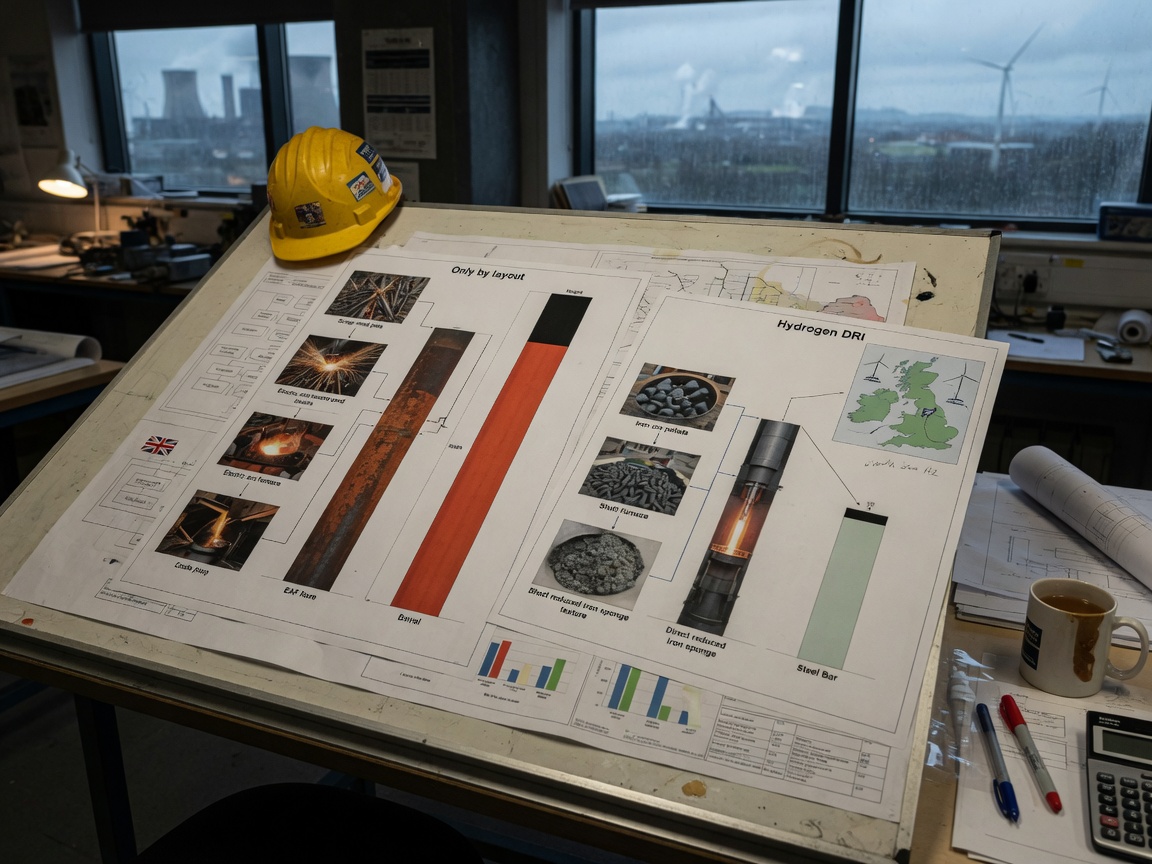
Two primary decarbonisation routes dominate industry debate in 2026: scaling up electric arc furnace steel using low carbon electricity, and transitioning to hydrogen steel production via direct reduced iron. Both have merit; neither is without constraint. The right route for the UK depends significantly on local energy infrastructure.
Electric arc furnace: the near-term workhorse
Electric arc furnace technology uses scrap metal recycling as its primary feedstock, melting at extreme temperatures using electrical energy. Its carbon footprint is fundamentally determined by grid electricity carbon intensity. In the UK, the grid's renewable share has risen above 50% on an annual average basis, meaning EAF operations are now meaningfully cleaner than a decade ago — and the trajectory continues to improve. British Steel's Scunthorpe transition plans and Liberty Steel's Sheffield operations both point toward accelerated EAF adoption. The capital cost of converting an integrated blast furnace site to EAF is substantial — estimates range from £200 million to £500 million per site — but the operating cost advantage from avoiding coking coal is growing as coal prices remain elevated. According to near research, EAF steel currently accounts for around 30% of UK production, compared to roughly 70% globally in high-income markets such as the US and Italy.
Hydrogen steelmaking: the long-term pathway
Hydrogen steel production — specifically green hydrogen-based direct reduction of iron ore (H-DRI) — is the most credible route to near-zero carbon steel. Projects like HYBRIT in Sweden and H2 Green Steel have entered commercial-scale production, demonstrating that the technology works. The question for UK feasibility is cost. Green hydrogen in 2026 costs approximately £4–£6 per kilogram in the UK, compared to the £1.50–£2.00 needed for hydrogen DRI to be cost-competitive with conventional blast furnace steel at current energy prices. Industry consensus is that cost parity is achievable by 2031–2034, contingent on continued renewable electricity build-out and electrolyser scale-up. Of course, there is an important exception here: sites with access to dedicated offshore wind-linked hydrogen supply — such as those in the Humber industrial cluster — could achieve viable economics several years ahead of the national average. Net zero steel at scale in the UK is not a 2026 reality; it is a 2032–2040 ambition with a credible engineering foundation.
"Steel is the most recycled material on the planet, and its structural efficiency per unit of embodied carbon continues to improve year on year. For UK developers committed to BREEAM Excellent ratings, modern structural steelwork represents a genuinely compelling environmental choice." — Steel Construction Institute, 2026 Sustainability Report
Steel certifications in the UK: how to choose the right standard
The UK green steel certification landscape is fragmented — and that fragmentation creates genuine buyer risk. Choosing the wrong standard can mean paying a green premium for steel that does not satisfy your client's sustainability requirements or your project's planning conditions.
Comparing the main UK certification frameworks
Three standards dominate UK procurement conversations in 2026. ResponsibleSteel is an international multi-stakeholder standard covering environmental, social, and governance performance at site level — it is increasingly required by automotive OEMs and large infrastructure clients. BSI's PAS 2060 focuses specifically on carbon neutrality claims and requires transparent carbon accounting aligned with GHG Protocol methodology, making it well-suited for project-level embodied carbon commitments. SSAB Zero is a product-level certification tied specifically to fossil-free steel produced via hydrogen DRI; its applicability is currently limited to SSAB-sourced supply chains but serves as a useful benchmark for what genuinely low carbon steel looks like at a product level. Environmental Product Declarations (EPDs) sit across all of these as the mandatory transparency layer — without a third-party verified EPD, any carbon intensity claim should be treated with scepticism.
Which certification should you specify?
For UK construction and infrastructure projects, specifying a Type III EPD (conforming to EN 15804+A2) is the non-negotiable baseline. Layer ResponsibleSteel site certification on top if your project involves supply chain due diligence obligations under the UK Modern Slavery Act or ESG reporting frameworks. For net zero-aligned projects with science-based targets, require PAS 2060-compliant carbon neutrality documentation from your steel supplier. The honest reality is that very few UK suppliers can currently satisfy all three simultaneously — which is precisely why stating your requirements clearly at tender stage is essential, rather than accepting vague "sustainable sourcing" declarations after contract award.
Lifecycle carbon footprint of steel: methodology and tools for UK buyers
Understanding steel's environmental impact requires moving beyond production-gate emissions. A full lifecycle assessment captures extraction, processing, fabrication, in-use performance, and end-of-life recycling — and the numbers shift dramatically depending on which boundary you draw.
The four lifecycle stages that matter
The EN 15978 standard, which governs embodied carbon calculation for UK construction projects, divides the steel lifecycle into four modules. Module A1–A3 covers raw material extraction through factory gate production — this is where the blast furnace vs EAF difference is most visible. Module A4–A5 adds transport and on-site installation carbon. Module C covers end-of-life demolition and recycling, and Module D captures the benefit of recycled steel displacing virgin production — this credit is particularly significant for steel, often reducing the net embodied carbon figure by 20–30%. UK buyers using the RICS Whole Life Carbon Assessment framework or the LETI Embodied Carbon Primer will already be familiar with these modules; the key is ensuring your steel supplier provides EPD data at the same system boundary.
Practical carbon accounting tools for UK projects
Several carbon calculation tools are directly applicable to UK steel buyers in 2026. The One Click LCA platform integrates manufacturer-specific EPD data and is widely used by UK engineering consultancies. The RICS/LETI Carbon Calculator provides a simpler spreadsheet-based approach suitable for smaller projects. For those undertaking Scope 3 supplier emissions reporting under TCFD or ISSB standards, the GHG Protocol Corporate Value Chain Standard (Scope 3) provides the methodological backbone, and most major UK steel suppliers can now provide Scope 3 Category 1 (purchased goods) emissions factors on request. Where verified EPD data is unavailable, the UK's CIBSE TM65 default carbon factors for structural steel provide a defensible conservative estimate, though they typically overstate emissions for EAF-produced steel.
Practical green steel procurement guide for UK buyers
Sourcing low carbon steel in the UK is achievable today — but it requires deliberate specification, not passive hope. Here is a structured approach drawn from real procurement experience across construction, infrastructure, and automotive supply chains.
Step-by-step procurement process
- Define your carbon target first. Establish whether you need a carbon intensity limit (e.g., <600 kg CO₂/tonne), a product-level EPD, or a site-level certification. Vague sustainability requirements generate vague responses.
- Request third-party verified EPDs at tender stage. Specify EN 15804+A2 conformance and insist on A1–A3 scope as a minimum, with Module D data if you are using whole-life carbon accounting.
- Assess your supplier's electricity source. For EAF suppliers, ask directly what percentage of their electricity comes from renewable sources, and whether they hold Renewable Energy Guarantees of Origin (REGOs). This single factor can halve or double the carbon intensity of nominally identical EAF steel.
- Check scrap metal recycling content. High scrap content reduces embodied carbon significantly. UK-sourced scrap also reduces transport emissions and supports circular economy steel supply chains domestically.
- Verify CBAM and UK ETS compliance documentation. For any imported steel, request the embedded carbon declaration required under CBAM rules — this document simultaneously confirms the product's carbon intensity and your CBAM liability exposure.
- Benchmark against the SSAB Zero or ResponsibleSteel standard even if you do not mandate them. They provide useful reference points for what credible eco-friendly steel procurement looks like at market frontier.
Sector-specific considerations
For UK building and construction buyers, the Future Homes Standard and updated Part Z embodied carbon proposals make EPD documentation a near-certain future planning requirement — specifying it now puts you ahead of the regulatory curve. For automotive supply chains, Jaguar Land Rover, Stellantis, and other UK OEMs are already cascading Scope 3 reduction requirements to Tier 1 and Tier 2 suppliers; steel emissions reductions are one of the largest single levers available. Infrastructure procurers — particularly those working on National Highways or Network Rail contracts — should note that both organisations have published supply chain carbon standards that explicitly reference steel carbon intensity thresholds. Why do so many procurement teams still fail to specify these requirements at tender stage? Largely because the commercial teams and sustainability teams operate in silos. Closing that gap is the single highest-leverage action available to most UK buying organisations in 2026. For a broader grounding in the subject, the sustainable steel overview on Wikipedia provides a useful starting framework, while the steel sustainability initiatives published by the World Steel Association provide more technical depth. For end-of-life recycling metrics, the steel recycling and sustainability data from the US EPA provides comparable international benchmarking data.
Steel sustainability trends shaping UK industry in 2026
The 2026 UK steel sustainability landscape is moving faster than at any point in the past two decades. Several converging forces are reshaping what is technically possible, commercially viable, and politically required.
British Steel sustainability commitments and domestic production shifts
British Steel sustainability commitments have become a central reference point for UK industry. The company's announced transition of its Scunthorpe site from blast furnace to electric arc furnace production — supported by government co-investment — represents the most significant single decarbonisation event in UK steel history. When fully operational, the new EAF configuration is projected to reduce site-level CO₂ emissions by approximately 75% compared to current BF-BOF operations. That is not a marginal improvement; it fundamentally changes the carbon intensity of UK-produced long steel products. Just as a ship changes course slowly but travels far once the rudder turns, the momentum behind this transition will reshape supplier options and market pricing for the rest of the decade.
The circular economy steel opportunity
Steel emissions reduction through circular economy principles offers the fastest near-term gains. Improving scrap collection rates, increasing the use of scrap metal recycling in domestic EAF production, and designing structures for disassembly — so that structural sections can be reused rather than recycled — all reduce embodied carbon without waiting for new technology deployment. The Steel Construction Institute estimates that reuse of structural sections avoids approximately 97% of the embodied carbon compared to producing equivalent new steel sections. That figure is striking. Main barriers remain commercial: reused steel sections require inspection, certification, and matching to new structural requirements, adding procurement complexity that most project teams currently lack the expertise or time to manage. The market infrastructure to support this at scale is developing in the UK, but it is not yet mature.
PAA: key questions on steel sustainability answered
What is the carbon footprint of steel production in the UK?
UK blast furnace steel production generates approximately 1,700–1,900 kg CO₂ per tonne of crude steel. Electric arc furnace steel using average UK grid electricity produces 500–750 kg CO₂ per tonne. EAF steel powered by certified renewables falls to 120–200 kg CO₂ per tonne. These figures represent A1–A3 (cradle-to-gate) emissions per EN 15804 methodology and are the relevant inputs for embodied carbon calculations in UK construction projects.
How does hydrogen steelmaking reduce emissions?
Conventional blast furnace steelmaking uses coke (derived from coal) as a reducing agent to strip oxygen from iron ore, producing large quantities of CO₂ in the process. Hydrogen steel production replaces coke with green hydrogen — the reduction reaction produces water vapour rather than CO₂. Combined with renewable-powered electric arc furnaces to melt the resulting direct reduced iron, the process can achieve a steel carbon footprint below 200 kg CO₂ per tonne, representing a reduction of over 90% compared to the blast furnace route.
What is an EPD for steel and why does it matter?
An Environmental Product Declaration (EPD) is a third-party verified, standardised document reporting the lifecycle environmental impacts of a specific steel product — including its carbon footprint, energy consumption, and water use — against the EN 15804+A2 standard. For UK procurement teams, it is the only reliable basis for comparing the environmental impact of competing steel products. Without an EPD, sustainability claims from suppliers are unverifiable. Increasingly, UK planning authorities and infrastructure clients require EPDs as a condition of contract.
Is recycled steel really more sustainable?
Yes — provided the electricity used in the electric arc furnace has low carbon intensity. Recycled steel (produced via EAF from scrap) avoids the iron ore mining and coking coal reduction stages entirely, which account for the majority of blast furnace emissions. Steel's ability to be recycled indefinitely without quality degradation makes it a cornerstone material for circular economy strategies. However, the quality of recycled steel for high-specification applications can be constrained by scrap contamination, meaning some product grades still require virgin iron input even in EAF routes.
How does the EU CBAM affect UK steel buyers in 2026?
CBAM directly affects UK companies that either export steel products to the EU or import steel from non-EU countries into the UK for re-export. For EU-bound exports, UK producers must demonstrate their embedded carbon and pay CBAM certificates for any carbon price gap. For UK buyers importing steel from high-emission producers, CBAM has created incentive to switch to lower-carbon sources — since the embedded carbon declaration process increases transparency and accountability throughout the supply chain, even for purely domestic UK transactions.
In summary, steel sustainability in 2026 is defined by the intersection of regulatory pressure, technology maturity, and procurement discipline. The UK has the policy framework, the industrial assets, and — with the right specification practices — the supply chain capability to make genuinely low carbon steel the default choice within this decade. The gap between ambition and delivery narrows every time a procurement team makes the effort to ask for a verified EPD, specify a carbon intensity threshold, or engage a supplier in a meaningful conversation about their decarbonisation roadmap. That is where real progress is made.
Frequently asked questions
Q: What does steel sustainability mean for UK construction buyers?
A: For UK construction buyers, steel sustainability means sourcing steel with verified low embodied carbon — typically evidenced by a third-party EPD — and preferring suppliers operating electric arc furnaces powered by low carbon electricity. In 2026, it also means understanding your CBAM exposure and aligning steel specifications with BREEAM or Part Z embodied carbon targets on your project.
Q: Which UK steel certification standard should I require from suppliers?
A: At minimum, specify a Type III EPD conforming to EN 15804+A2. For supply chain due diligence, add ResponsibleSteel site certification. For net zero-aligned project commitments, require PAS 2060 carbon neutrality documentation. Most UK suppliers can satisfy the EPD requirement today; full ResponsibleSteel certification is becoming more common but is not yet universal.
Q: What is the difference between EAF steel and hydrogen steel?
A: EAF (electric arc furnace) steel melts scrap metal using electrical energy, producing significantly lower emissions than blast furnace steelmaking — especially when the electricity is from renewable sources. Hydrogen steel uses green hydrogen to chemically reduce iron ore, avoiding carbon entirely at the reduction stage. EAF is commercially mature today; hydrogen steelmaking is scaling commercially but is not yet cost-competitive in the UK without policy support.
Q: How is the EU CBAM calculated for steel imports?
A: CBAM is calculated based on the verified embedded carbon content of the steel product (in tonnes CO₂ per tonne of steel) multiplied by the difference between the EU ETS carbon price and any equivalent carbon price already paid in the country of origin. For high-emission steel with no equivalent carbon pricing, the CBAM cost in 2026 can reach €80–€100 per tonne of finished steel at current EU ETS prices.
Q: Can structural steel be reused rather than recycled to save more carbon?
A: Yes — reuse of structural steel sections avoids approximately 97% of the embodied carbon compared to producing equivalent new sections, according to Steel Construction Institute data. Recycling, while still valuable, involves re-melting and re-rolling, which consumes energy. Reuse preserves the energy already embedded in the product. The main barriers are inspection, certification costs, and limited market infrastructure, though these are improving in the UK as circular economy steel practices mature.
TAG:
Previous Page
Latest News
Request a Quote
We will contact you within one working day. Please pay attention to your email.
正昌集团
+86 158 3282 8988
No. 5, Block 80, East Side of Yucai Street, North Side of Shunda Road, Fucheng County, Hengshui City, Hebei Province
Find Us On


Get more information anytime


Copyright © 2026Rucheng Construction Group Co., Ltd
Powered by 300.cn | TAG | Privacy Policy