


News Information
Blog
How to choose reliable steel structure companies: a practical guide for buyers
Release time:
30 Sep,2026
Author:
Rucheng Construction
Looking for reliable steel structure companies in the UK? This 2026 guide covers costs, compliance, regional coverage, sustainability, and how to evaluate structural steelwork companies with confidence.
Article overview
This guide helps UK procurement managers and project leads evaluate, compare and appoint reliable steel structure companies. Topics include BS EN 1090 compliance, regional service coverage, £/m² cost benchmarks, sustainability credentials, and a structured shortlisting process.
Table of contents
- 1. What steel structure companies actually do
- 2. UK compliance and certification: what buyers must verify
- 3. How to estimate steel construction costs in the UK
- 4. Steel vs concrete vs timber: a decision framework
- 5. Regional coverage across England, Scotland, Wales and Northern Ireland
- 6. Sustainability and carbon: the 2026 imperative
- 7. How to evaluate and shortlist steel structure companies
- 8. Frequently asked questions
What steel structure companies actually do
Steel structure companies are specialist engineering and construction firms that design, fabricate, supply and erect load-bearing steel frameworks for industrial, commercial and residential buildings. They sit at the intersection of structural engineering, precision manufacturing and on-site construction — making them a fundamentally different proposition from a general builder or a materials merchant.
The scope of services varies considerably across the sector. Some firms operate purely as building steel fabricators, producing beams, columns and connections in a controlled factory environment before delivering them to site. Others function as full-service structural steel contractors, managing everything from initial design through to final bolt-up and handover. Understanding where a company sits on this spectrum is the first question a buyer should ask — because appointing a fabricator when you need a turnkey contractor is a costly misalignment.
The main types of steel structure companies in the UK
The UK market segments broadly into five company types, each suited to different project profiles:
- Industrial and warehouse specialists — focused on portal frame buildings, logistics hubs and manufacturing facilities. High volume, competitive pricing, fast delivery.
- Commercial and multi-storey contractors — experienced in complex multi-floor steel frame buildings, requiring composite floor systems and façade coordination.
- Prefabricated steel structure suppliers — offer off-the-shelf or semi-custom modular solutions. Ideal for agricultural buildings, budget-conscious industrial projects and rapid deployment.
- Heavy infrastructure firms — bridges, gantries, transmission towers. Highly specialised; rarely overlap with building sectors.
- Light gauge and residential companies — cold-formed steel for housing and extensions. A growing niche driven by the UK's off-site construction agenda.
Why does this distinction matter? Because a large metal structure manufacturer with a £50m annual turnover and a full in-house design team may refuse to quote on a 500 m² agricultural building — and rightly so. Matching project scale to company capability is a discipline in itself.
What services should a full-service contractor provide?
A credible steel construction firm operating in the UK should, at minimum, offer structural design or design coordination, steel fabrication to BS EN 1090 standards, corrosion protection and intumescent fire coating, on-site erection by trained steelwork gangs, and a clear warranty on both materials and workmanship. Any supplier who cannot articulate their process across all five stages warrants additional scrutiny before appointment.
UK compliance and certification: what buyers must verify
Regulatory compliance is the single most important differentiator when evaluating steel structure companies in the UK — and the area most frequently overlooked in competitor content. The consequences of appointing a non-compliant fabricator range from building control rejection through to structural liability and invalidated insurance.
BS EN 1090 CE marking: the non-negotiable baseline
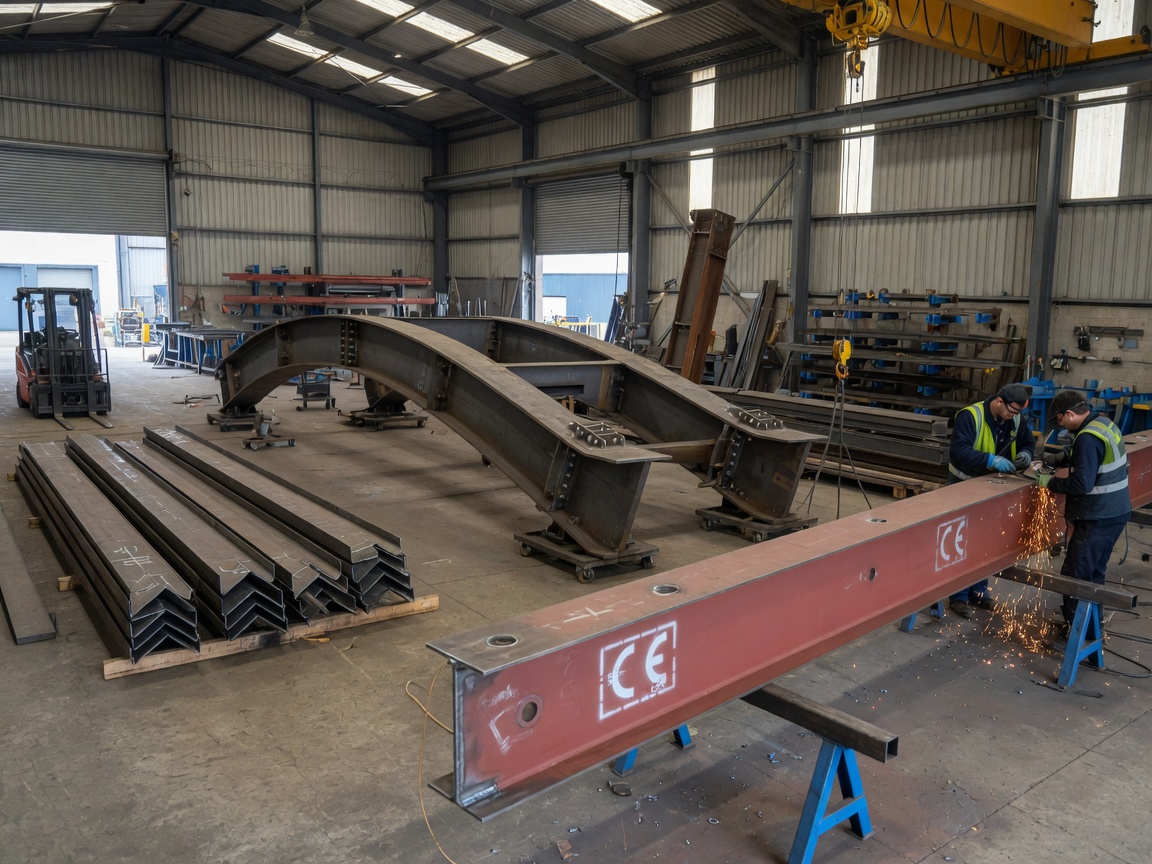
Since 2014, all structural steelwork placed on the UK market must comply with BS EN 1090, the harmonised European standard for structural steel and aluminium components. Post-Brexit, the UK has retained this standard. CE marking (or UKCA marking for Great Britain supply) confirms that a fabricator has a certified Factory Production Control system audited by a notified body. Without it, your building control application is likely to stall.
Execution class matters too. EXC2 covers most standard commercial and industrial buildings. EXC3 applies to structures in higher consequence categories — tall buildings, bridges, or structures subject to fatigue loading. Always ask a prospective supplier for their current BS EN 1090 certificate and confirm the execution class scope.
Building Regulations Part A and structural design responsibility
Under Building Regulations Approved Document Part A (Structure), all structural elements must be designed to demonstrate adequate strength, stability and robustness. For steel structures, this typically means design to Eurocode 3 (BS EN 1993) by a chartered structural engineer. Reputable structural steelwork companies will either employ in-house chartered engineers or work with a named design partner — and will provide full design calculations as part of the contract deliverables. If a contractor is vague about who holds design responsibility, treat that as a serious red flag.
Additional certifications worth requesting include CHAS or Constructionline accreditation (demonstrating supply chain compliance), ISO 9001 quality management, and Safe Contractor approval for health and safety competency.
"Structural steel is only as safe as the system that produced it. BS EN 1090 is not a box-ticking exercise — it is the framework that ensures every weld, every bolt and every connection meets the load assumptions in the structural calculation." — Steel Construction Institute (SCI), Good Practice Guide 2025
How to estimate steel construction costs in the UK
Cost transparency is one of the biggest pain points reported by UK buyers. Based on 2026 data from quantity surveying benchmarks and industry tender analysis, the following table provides a realistic cost reference by building type. Note that these are supply-and-erect figures for the structural steelwork package only — they exclude groundworks, cladding, M&E and fit-out.
| Building type | Typical span | Steel structure cost (£/m² GIA) | Notes |
|---|---|---|---|
| Portal frame warehouse | 20–40 m | £55–£95 | Lower end for standard repeating bays |
| Industrial manufacturing unit | 15–30 m | £70–£120 | Higher if crane beams required |
| Commercial office frame (3–5 storey) | 6–12 m bays | £110–£180 | Composite deck adds cost |
| Retail or leisure building | 12–25 m | £80–£140 | Varies with architectural complexity |
| Agricultural or rural steel building | 10–20 m | £40–£70 | Often prefabricated steel structures |
What drives cost variation — and what buyers commonly miss
Here is a point that genuine industry experience reinforces repeatedly: the headline steel tonnage cost is rarely where projects go over budget. Corrosion protection specification (C3 vs C4 vs C5 environment category under ISO 12944) can add £8–£25/m² alone. Intumescent fire protection for a 60-minute or 90-minute rating adds further. Complex bespoke connections — knife plates, moment-resisting frames, haunch details — drive fabrication hours up sharply compared with standard bolted connections.
The misconception that steel is always cheaper than concrete is worth addressing directly. For clear-span industrial structures over 20 m, steel frame construction is typically more economical and faster. For low-rise structures under 500 m², the differential narrows considerably once fire protection and corrosion treatment are properly accounted for. Get comparable quotes for both structural forms on any project below 1,000 m² before committing.
Lead times and programme implications
In 2026, UK steel fabrication lead times are running at approximately 8–14 weeks from order to delivery for standard industrial buildings, and 14–22 weeks for complex commercial frames. Steel erection companies typically need 2–4 weeks on site for a standard portal frame warehouse. Factor these into your programme early — late appointment of a steel building supplier is one of the most common causes of construction programme overrun in the UK.
Steel vs concrete vs timber: a decision framework
The choice of structural material is a genuine decision, not a foregone conclusion. The right answer depends on span, height, site access, programme, budget and occupancy class. This comparison is designed to support — not replace — specialist structural engineering advice.
Comparative strengths across key criteria
| Criterion | Structural steel | Reinforced concrete | Engineered timber (CLT/glulam) |
|---|---|---|---|
| Long-span capability (>20 m) | Excellent | Moderate | Limited |
| Construction speed | Fast | Slow (curing time) | Fast |
| Embodied carbon | Moderate (high recyclability) | High | Low |
| Fire performance (inherent) | Requires protection | Good inherently | Char layer provides protection |
| Future adaptability | Excellent | Poor | Moderate |
| Corrosion risk | Requires treatment | Low (if cover adequate) | Requires moisture control |
When steel is clearly the right choice
According to steel construction applications research from the AISC, steel consistently outperforms concrete in long-span industrial buildings, multi-storey structures requiring future floor plan flexibility, and projects where programme certainty is critical. For UK buyers commissioning steel warehouse construction, distribution centres, or multi-bay manufacturing units, it remains the material of choice. The adaptability argument is particularly compelling: commercial steel construction allows column removal, floor level additions and structural modifications in ways that concrete frames simply cannot accommodate.
Regional coverage across England, Scotland, Wales and Northern Ireland
One consistent gap in competitor content is the absence of region-specific guidance. The reality of procuring steel building suppliers UK-wide is that coverage, capability and cost vary significantly by geography. Here is what buyers should know.
England: concentration and competition
The majority of the UK's structural steelwork capacity is concentrated in the Midlands, Yorkshire and the North West — historically aligned with the UK's steel production heritage. The East Midlands in particular hosts several of the UK's largest steel fabrication companies. Competition is strong, which tends to keep prices competitive for buyers in these regions. In London and the South East, fabrication is largely undertaken off-site and transported in — factor haulage and logistics costs into your tender evaluation.
Scotland, Wales and Northern Ireland: regional considerations
Scotland has a strong indigenous steelwork sector, with competent steel framework contractors servicing the energy, marine and commercial sectors across Central Scotland and Aberdeen. Building Warrant (Scotland's equivalent of English building control) is administered by local authorities under the Building (Scotland) Act 2003 — the structural design requirements are broadly equivalent to England and Wales, but the submission process differs. Buyers should confirm that any appointed contractor is familiar with the Scottish procedure.
Wales operates under the same Building Regulations framework as England (with some devolved amendments), but the pool of specialist structural steelwork companies is smaller. For larger projects in Wales, it is common to appoint fabricators from the West Midlands or North West who mobilise fabrication gangs to site. Northern Ireland operates under its own Building Regulations (Technical Booklets), which also align with Eurocode structural design standards. Contractors with experience in the Northern Ireland market should be familiar with the Building Control provisions administered by district councils.
Sustainability and carbon: the 2026 imperative
In 2026, sustainability credentials are no longer a differentiator for progressive buyers — they are a baseline procurement requirement. The UK's legally binding net zero target, combined with mandatory embodied carbon reporting under the updated RIBA Plan of Work, means that your choice of steel structure companies directly affects your project's carbon footprint and regulatory exposure.
Why steel's recyclability story matters more than ever
Steel is, by mass, the world's most recycled material. According to steel in construction data from the American Iron and Steel Institute (mirrored by UK Steel industry figures), structural steel contains on average 93% recycled content when produced via electric arc furnace — the dominant manufacturing route for UK-consumed sections in 2026. This dramatically reduces embodied carbon compared with basic oxygen steelmaking.
When evaluating metal structure manufacturers, ask specifically: what is the recycled content of the steel sections? Is a product Environmental Product Declaration (EPD) available? Can the structure be designed for deconstruction, allowing steel recovery at end of life? These questions separate genuinely sustainable suppliers from those simply using green language for marketing purposes. The best steel construction firms in 2026 are also moving towards ISO 14001 environmental management certification and publishing scope 1 and scope 2 emissions data.
ESG credentials in procurement: practical steps
Practical testing confirms that incorporating a sustainability questionnaire within your tender process — rather than treating it as an afterthought — yields materially better responses and more honest self-assessment from bidders. Request EPDs, carbon management plans, and evidence of waste minimisation on recent comparable projects. For public sector contracts in particular, the Social Value Act 2012 requires commissioners to consider environmental and social factors. A contractor who cannot produce basic carbon data should be scored accordingly.
How to evaluate and shortlist steel structure companies
Shortlisting credible steel structure companies is not a passive process. It requires a structured approach that goes well beyond reviewing a company website or accepting the lowest tender price. Here is a proven evaluation sequence used by experienced procurement managers.
A step-by-step supplier evaluation process
- Define your project type and scope precisely — span, height, occupancy, programme, budget range and geographic location. This filters out unsuitable suppliers before you invest time in dialogue.
- Verify BS EN 1090 certification — request the current certificate, check the issuing notified body, confirm the execution class scope matches your project requirements.
- Check financial standing — use Companies House to review the last two years of filed accounts. A fabricator with deteriorating net assets or county court judgements represents a supply chain risk.
- Request a relevant project reference list — specifically ask for projects of comparable type, scale and complexity completed within the last three years. Ask whether you can speak directly to the client's project manager.
- Assess design and engineering capability — who holds structural design responsibility? Are they a chartered member of IStructE or ICE? How is the interface between fabrication drawings and the structural engineer's calculations managed?
- Evaluate the tender submission — does the bid address the specification fully? Are exclusions clearly stated? Is the programme realistic? A suspiciously low price with a vague programme deserves very careful scrutiny.
- Visit the fabrication facility — even a brief factory visit reveals more than any document. Look for organised production flow, evident quality control procedures, modern cutting and welding equipment, and BS EN 1090 documentation on display.
Red flags that experienced buyers know to watch for
Why do so many buyers end up with underperforming contractors despite a seemingly thorough process? Often, the warning signs were visible — they were simply not prioritised. Vague answers about design responsibility, an inability to name the certifying notified body, reluctance to provide client references, a price that is more than 20% below the next lowest tender — each of these merits a direct, documented challenge before award. Of course, there are cases where a new entrant to your market segment offers genuine value; the point is to verify rather than assume.
Just as a building's structural frame must distribute loads efficiently across every connection, your procurement process must distribute scrutiny equally across every evaluation criterion — not just price. The parallel is imperfect, but the principle holds.
Frequently asked questions
Common questions answered
Q: How long does a typical steel structure project take from enquiry to completion in the UK?
A: For a standard portal frame industrial building, allow 4–6 weeks for design and tender, 8–14 weeks for fabrication and 2–4 weeks for erection on site. Total timeline from initial enquiry to practical completion typically runs 20–28 weeks for straightforward projects. Complex multi-storey frames can take significantly longer.
Q: What corrosion protection standard should I specify for a UK industrial building?
A: For a typical inland UK industrial environment, corrosion category C3 (medium) under ISO 12944 is the standard minimum, typically achieved with a two-coat paint system. Coastal or chemically aggressive environments require C4 or C5 specification. Confirm the environment category with your structural engineer and specify it explicitly in the tender documents — do not leave it to the contractor's discretion.
Q: Do steel structure companies handle planning permission and building regulations approval?
A: This depends on the company's service scope. Many full-service structural steel contractors assist with building regulations submissions and coordinate with approved inspectors, but planning permission is typically the client's or architect's responsibility. Always clarify the scope of statutory approvals services in your contract before appointment.
Q: What warranty should I expect from a reputable steel fabrication company?
A: Industry standard practice is a 12-month defects liability period on workmanship from practical completion, with materials warranties aligned to the paint or galvanising system specification — typically 10–25 years for corrosion protection subject to proper maintenance. Structural design warranties are separate and should be covered by the structural engineer's professional indemnity insurance.
Q: Is UKCA marking now required instead of CE marking for steel fabrication in the UK?
A: For Great Britain (England, Scotland and Wales), UKCA marking is required for structural steelwork placed on the market, with CE marking currently still accepted under a transitional arrangement extended into 2026. Northern Ireland continues to require CE marking under the Windsor Framework. Confirm the current position with your contractor and building control body, as the regulatory transition timeline has been subject to government updates.
Conclusion: making the right appointment
Choosing between steel structure companies is ultimately about risk management as much as cost optimisation. The most expensive appointment you will ever make is a contractor who fails mid-project, delivers substandard fabrication, or produces a structure that building control will not sign off. The framework set out in this guide — verifying BS EN 1090 certification, understanding regional capability, benchmarking costs honestly, interrogating sustainability credentials and following a structured evaluation process — is designed to eliminate the most common points of failure.
The UK steel construction sector in 2026 is mature, competitive and increasingly technically sophisticated. There are excellent structural steel contractors at every scale of the market. The buyer's job is to find the right match for their specific project — not simply the cheapest price or the biggest name.
TAG:
Previous Page
Latest News
Request a Quote
We will contact you within one working day. Please pay attention to your email.
正昌集团
+86 158 3282 8988
No. 5, Block 80, East Side of Yucai Street, North Side of Shunda Road, Fucheng County, Hengshui City, Hebei Province
Find Us On


Get more information anytime


Copyright © 2026Rucheng Construction Group Co., Ltd
Powered by 300.cn | TAG | Privacy Policy