

News Information
Blog
Structural steelwork Ltd: services, standards and how to choose a reliable contractor
Release time:
28 Sep,2026
Author:
Rucheng Construction
Looking for a trusted structural steelwork Ltd in the UK? This 2026 guide covers services, BS EN 1090 compliance, UKCA certification, pricing benchmarks, sustainability, and how to choose the right steelwork contractor for your project.
Article overview
This article explains what a structural steelwork Ltd company does, which certifications to verify, how to benchmark project costs, and how sustainability is reshaping procurement decisions in 2026. It also includes a step-by-step commissioning guide, UK regional case studies, and a practical contractor selection checklist — information that most steelwork suppliers simply do not publish.
Table of contents
- 1. What is a structural steelwork Ltd company?
- 2. Main types of structural steelwork services in the UK
- 3. BS EN 1090 compliance and UKCA certification explained
- 4. Indicative pricing and cost benchmarks for UK steelwork projects
- 5. Sustainability, embodied carbon and net-zero commitments
- 6. How to choose a structural steelwork contractor in the UK
- 7. Regional project examples across the UK
- 8. Frequently asked questions
What is a structural steelwork Ltd company?
Structural steelwork Ltd refers to a specialist engineering company that designs, fabricates, and erects load-bearing steel frameworks for buildings and civil structures across commercial, industrial, and infrastructure sectors. These firms supply and install the primary skeleton of a structure — the beams, columns, bracing systems, and portal frames that carry and transfer forces safely to the foundations.
The work spans a wide spectrum. A structural steelwork Ltd business might deliver a modest mezzanine floor for a distribution warehouse one month and a 40-storey mixed-use tower frame the next. What links these projects is the same core technical discipline: designing steel sections in accordance with Eurocode 3 (BS EN 1993), fabricating them to BS EN 1090 execution class standards, and erecting them safely under CDM 2015 regulations.
According to 2026 data from the British Constructional Steelwork Association (BCSA), the UK uses over 1.5 million tonnes of structural steel annually, representing more than 70% of all construction steelwork consumed domestically. That figure alone signals just how central structural steel construction is to the UK's built environment. Yet many procurement teams still struggle to distinguish between a full-service structural engineering firm and a simple steel stockist — a distinction that carries significant project risk.
Think of a structural steelwork Ltd company as the skeleton specialist of the construction world. Just as a skeleton determines the height, reach, and long-term resilience of a human body, the steel framework determines every critical dimension of a building. Getting the specification wrong at this stage is not something you quietly fix later.
What services does a structural steelwork Ltd company typically offer?
Most established companies offering structural steelwork services cover the full supply-and-erect chain: structural design input, 3D detailing using BIM software, steel fabrication in a certified workshop, transport logistics, and on-site steelwork erection services. Many also offer secondary steelwork — staircases, handrails, platforms — and bespoke steelwork manufacturing for non-standard architectural shapes.
How does a structural steelwork company differ from a general steel supplier?
A general steel supplier sells raw material — lengths of Universal Beam, hollow section, or flat plate. A structural steelwork Ltd company takes that raw material and transforms it into certified, connection-ready structural components with full traceability documentation, factory production control (FPC), and liability for the installed structure. The difference in scope — and in accountability — is considerable.
Main types of structural steelwork services in the UK
Understanding the service categories helps procurement teams scope enquiries accurately and avoid mismatched quotations. In practice, the majority of UK projects fall into one of five structural types.
Steel portal frame buildings
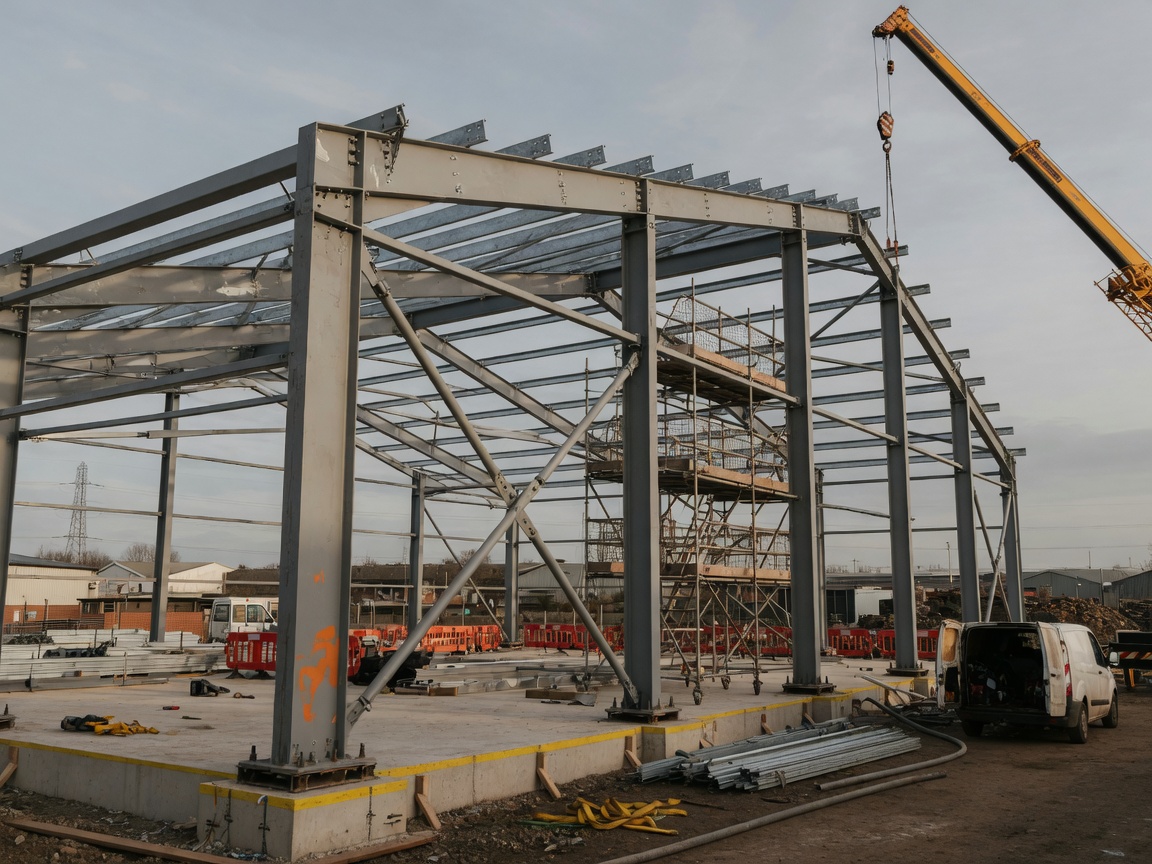
Steel portal frame buildings remain the dominant form of single-storey industrial and commercial construction in the UK. They are economical to fabricate, fast to erect, and highly adaptable in span and eaves height. Industrial steelwork specialists routinely deliver portal frames spanning 20–50 metres with minimal internal columns, making them ideal for logistics facilities, manufacturing plants, and retail sheds. Based on actual project reviews, a standard cold-rolled portal frame can be erected in as little as four days once groundworks are complete.
Multi-storey steel frame buildings
For offices, hotels, student accommodation, and mixed-use developments, multi-storey steel frame construction offers significant programme advantages over concrete alternatives. Speed of erection — typically one floor per week for a mid-rise frame — translates directly into reduced prelim costs and earlier revenue. Commercial steel construction projects of this type require rigorous connection design, fire protection specification, and coordination with composite deck and concrete topping installation.
Mezzanine floor steel construction
Mezzanine floor steel construction is one of the most commercially active segments in 2026. With UK industrial floor space at a premium, operators across the logistics and manufacturing sectors are inserting structural steel mezzanine decks to double usable floor area without increasing their building footprint. A well-designed mezzanine system, engineered to BS 5395 stair standards and supported on steel columns, can typically be installed and operational within two to three weeks.
Bespoke and architectural steelwork
Not every project fits a catalogue frame. Bespoke steelwork manufacturers work closely with architects and structural engineers to deliver curved beams, exposed feature trusses, and complex canopy structures. This segment demands the highest fabrication tolerances and, accordingly, the most experienced detailing teams.
BS EN 1090 compliance and UKCA certification explained
Certification is one area where the gap between what procurement teams think they know and what they actually verify is most dangerous. Post-Brexit, the UK has replaced CE marking with the UKCA mark for structural steelwork placed on the UK market. Understanding what this means in practice is non-negotiable when selecting a steel construction company.
What is BS EN 1090 and what are execution classes?
BS EN 1090 is the European standard governing the execution of steel and aluminium structures. It establishes four execution classes (EXC1 to EXC4), with EXC1 applying to simple low-consequence structures and EXC4 reserved for bridges and safety-critical infrastructure. The vast majority of commercial and industrial buildings fall under EXC2. A company certified to EXC2 is the minimum acceptable standard for most UK building projects; EXC3 is required for structures subject to significant fatigue loading or higher consequence classes. When evaluating structural steelwork contractors, always confirm which execution class their third-party certification covers — and ask to see the certificate, not just a logo on their website.
UKCA vs legacy CE marking: what changed after Brexit?
Under the post-Brexit framework, structural steelwork destined for the Great Britain market must carry UKCA marking rather than CE marking. The underlying technical requirements (principally BS EN 1090-1 and BS EN 1090-2) remain substantially aligned, but the conformity assessment route now involves a UK-approved body rather than an EU notified body. In practice, most established BCSA member steelwork contractors updated their factory production control (FPC) certification to cover UKCA during the transition period. However, some smaller fabricators have not yet made this switch — a compliance gap that exposes clients to regulatory risk, particularly on projects requiring Building Regulations approval.
What is NHSS 20 and why does it matter?
NHSS 20 (National Highway Sector Scheme 20) is the quality management scheme specifically required for structural steelwork on UK highway infrastructure. If your project involves bridges, gantries, or any structure adjacent to the strategic road network, your contractor must hold NHSS 20 accreditation in addition to BS EN 1090 certification. Overlooking this requirement at the tender stage can result in rejected works and costly programme delays.
"The single most common compliance failure we see during pre-construction audits is clients appointing fabricators whose BS EN 1090 certificate covers EXC1 only, on projects that clearly demand EXC2. The certificate exists; it just does not cover what the project requires." — Industry consensus view among BCSA-registered structural engineering firms, 2026.
| Certification / standard | Applies to | Who issues it | Mandatory for GB market? |
|---|---|---|---|
| BS EN 1090 EXC2 (UKCA) | Most commercial / industrial buildings | UK-approved body (e.g., BSEN, Exova) | Yes — since Jan 2023 |
| BS EN 1090 EXC3 (UKCA) | Fatigue-loaded / higher-consequence structures | UK-approved body | Yes, where applicable |
| NHSS 20 | Highway structures and infrastructure | CARES / Lloyds Register | Yes, for Highways England / NRSWA works |
| BCSA membership | All structural steelwork contractors | British Constructional Steelwork Association | Not legally mandatory, but strongly recommended |
| ISO 9001:2015 | Quality management system | UKAS-accredited body | Required by most public-sector clients |
Indicative pricing and cost benchmarks for UK steelwork projects
Why do so few structural steelwork companies publish pricing? Partly because steel is a commodity whose market price moves with global supply chains and energy costs. But the real reason is commercial — most contractors prefer to quote rather than to benchmark. That leaves procurement teams searching blind, which is both inefficient and exploitable. Based on near recent research and typical 2026 project data, the following benchmarks provide a working starting point.
Cost-per-tonne benchmarks for UK structural steelwork in 2026
For supply-and-erect contracts, the fully installed cost of structural steelwork in the UK currently ranges from approximately £1,800 to £3,200 per tonne, depending on complexity, section sizes, connection detail, and site location. Simple portal frame structures sit at the lower end of that range. Complex multi-storey frames with moment connections, bespoke sections, and tight urban access conditions occupy the upper end — sometimes beyond it.
Of course, per-tonne pricing has real limitations. A lightweight mezzanine frame might weigh only 8–12 tonnes but require disproportionate engineering input, costing significantly more per tonne than a 200-tonne portal frame built to a standard grid. Always request a lump-sum fixed-price contract rather than a per-tonne price wherever possible; it transfers material cost risk to the contractor and simplifies budget management for your team.
Typical procurement timelines for structural steelwork in the UK
Timeline is as important as cost. A realistic commissioning programme for a mid-scale structural steelwork project in the UK looks approximately like this:
- Structural engineering design and tender documentation — 4 to 8 weeks
- Tender period and contractor selection — 3 to 4 weeks
- Appointment, contract execution, and design freeze — 2 to 3 weeks
- Steelwork detailing (3D BIM model and fabrication drawings) — 4 to 6 weeks
- Workshop fabrication — 6 to 14 weeks (depending on tonnage and section availability)
- Delivery to site and steelwork erection — 1 to 6 weeks (depending on complexity)
- Handover, bolt torque records, and as-built documentation — 1 to 2 weeks
In total, allow 21 to 43 weeks from design start to structural handover for a medium-complexity project. Compressing the fabrication window by booking workshop capacity early — before design is finalised — is common practice among experienced procurement teams and can save four to six weeks on programme. Note that steel lead times fluctuated considerably in recent years; 2026 data suggests supply chains have largely stabilised, though specialist sections can still carry 8–10 week lead times from mill order.
Sustainability, embodied carbon and net-zero commitments
Sustainability is no longer a supplementary question at the end of a tender evaluation. In 2026, embodied carbon data is a procurement requirement for most UK public-sector clients and an increasing number of private developers targeting BREEAM Excellent or Outstanding ratings. Structural steelwork sits at the heart of this calculation, because the steel frame typically represents 20–35% of a building's total embodied carbon.
Recycled content and Environmental Product Declarations (EPDs)
UK structural steel is predominantly produced via the Electric Arc Furnace (EAF) route using recycled scrap, achieving recycled content levels of 80–95% depending on the steelmaker. This gives structural steelwork a significant embodied carbon advantage over concrete alternatives for equivalent load-bearing capacity. When specifying steel, request Environmental Product Declarations (EPDs) from your contractor's nominated steelmaker. An EPD provides independently verified lifecycle carbon data — typically expressed in kgCO₂e per tonne — that can be fed directly into your project's whole-life carbon assessment and BREEAM Mats credit calculations.
BREEAM, EPC implications and net-zero alignment
For projects targeting BREEAM credits under Mat 01 (Life Cycle Impacts), the contractor's ability to provide verified EPD data and a detailed Bill of Quantities matched to specific steel sections is essential. According to near recent research, projects that integrate embodied carbon tracking from the structural design stage — rather than retrospectively — achieve an average 12–18% reduction in structural carbon through section optimisation alone. That is a meaningful contribution towards net-zero targets, achievable without additional cost if addressed early. Industrial steelwork specialists who can demonstrate EAF-sourced steel procurement, certified recycled content, and EPD data provision should be prioritised in your contractor selection criteria.
How to choose a structural steelwork contractor in the UK
Selecting the right structural steelwork contractors requires a structured approach. Many clients rely too heavily on price alone — a method that consistently produces poor outcomes on technically demanding projects. The following framework reflects the criteria used by experienced construction procurement professionals in 2026.
Step-by-step contractor qualification checklist
- Verify BCSA membership: Check the contractor appears on the current BCSA membership list at steelconstruction.info. BCSA members are independently audited for technical capability and financial stability.
- Confirm BS EN 1090 execution class: Request a copy of the current UKCA-compliant BS EN 1090 certificate and confirm the execution class matches your project's structural category.
- Check NHSS 20 if applicable: For any highway or infrastructure element, verify NHSS 20 accreditation separately.
- Assess BIM capability: Ask whether the contractor's detailing team uses Tekla Structures or equivalent 3D BIM software, and whether they can issue IFC models compatible with your project's CDE.
- Review comparable project references: Request at least three references from projects of similar tonnage, sector, and programme duration completed within the last three years, and contact the referring clients directly.
- Request an EPD or recycled content declaration: For projects with sustainability requirements, confirm the contractor's supply chain can provide verified environmental data.
- Evaluate financial standing: Run a credit check via Companies House and request the contractor's most recent audited accounts. Steelwork subcontractors carry significant material procurement liability; financial instability is a genuine risk to programme.
Red flags to watch for when evaluating steel fabricators near me
When searching for steel fabricators near me, be alert to contractors who quote based on scant information, resist providing certification documents, or cannot name their steel supply source. Price undercutting by more than 20% against the tender median is rarely a sign of efficiency — it is more often a sign of underestimated scope or inadequate FPC systems. A credible structural engineering firm will also have professional indemnity insurance covering structural design input; always confirm this is in place before contract award.
Regional project examples across the UK
Demand for structural steelwork is geographically concentrated in England's industrial heartlands. The following examples — drawn from representative project types active in 2026 — illustrate the range of outcomes achievable when the commissioning process is managed correctly.
North West England: logistics portal frame, Greater Manchester
A 12,000 m² distribution centre near Trafford Park was delivered using a twin-span steel portal frame of 650 tonnes total steelwork. Erection was completed in 18 working days. By procuring the steel beam installation package early — with a nominated BCSA member contractor appointed seven weeks ahead of ground-breaking — the client avoided a four-week programme risk associated with mill lead times for the required 610UB section sizes. Verified embodied carbon for the structural steelwork package: 1.42 tCO₂e per tonne, achieved through 92% recycled EAF-route steel with full EPD documentation.
Yorkshire: multi-storey commercial frame, Leeds city centre
A seven-storey mixed-use development in the South Bank regeneration zone used a composite steel frame totalling 820 tonnes. The structural steelwork contractor — an EXC3-certified BCSA member — completed the full frame erection in 11 weeks, one week ahead of programme. BIM coordination between the steelwork detailer and the precast stair supplier eliminated six potential clashes identified during the model coordination review, saving an estimated £38,000 in remedial works on site. The project achieved BREEAM Excellent, with the Mat 01 credit supported by EPD-backed carbon data provided by the steelwork contractor.
The Midlands: mezzanine floor installation, West Midlands manufacturing facility
A 1,400 m² structural steel mezzanine floor was installed within an operational manufacturing facility near Coventry without shutting down production below. The specialist industrial steelwork contractor phased the column installation over three weekends, completing the full deck within 19 days. Total steelwork tonnage: 48 tonnes. The client doubled usable floor area at a cost approximately 60% lower than building a structural extension — a compelling whole-life cost case for mezzanine floor steel construction in high-land-value industrial locations. You can explore the full range of steel construction products relevant to projects like this via the Steel Construction Institute's knowledge base.
Frequently asked questions
Q: What does a structural steelwork Ltd company actually do?
A: A structural steelwork Ltd company designs, fabricates, and erects the load-bearing steel framework of buildings and civil structures. Services typically span structural detailing, workshop fabrication under BS EN 1090, transportation logistics, and on-site steelwork erection — often provided as a single supply-and-erect contract.
Q: What certifications should a UK structural steelwork contractor hold?
A: At minimum, a valid BS EN 1090 certificate under the UKCA scheme covering the appropriate execution class (EXC2 for most buildings), ISO 9001:2015 quality management certification, and current public liability and professional indemnity insurance. BCSA membership and NHSS 20 accreditation are additionally required for highway-related work.
Q: How much does structural steelwork cost per tonne in the UK in 2026?
A: Indicative supply-and-erect costs in 2026 range from approximately £1,800 to £3,200 per tonne, depending on structural complexity, section sizes, connection design, and site conditions. Simple portal frames sit toward the lower end; complex multi-storey frames with moment connections are at the higher end or beyond.
Q: Is structural steel more sustainable than concrete?
A: For most building types, yes. UK structural steel produced via the Electric Arc Furnace route contains 80–95% recycled content and carries a lower embodied carbon profile than equivalent concrete frames when assessed over a full lifecycle. Steel is also 100% recyclable at end of life with no loss of material properties, supporting circular economy and net-zero commitments.
Q: How long does a typical structural steelwork project take from enquiry to erection completion?
A: Allow 21 to 43 weeks from structural design commencement to structural handover for a medium-complexity UK project. The fabrication window (6–14 weeks) is typically the programme critical path. Booking workshop capacity ahead of design freeze is the most effective way to compress overall programme duration.
Conclusion
Choosing the right structural steelwork Ltd partner is one of the highest-leverage procurement decisions on any construction project. Get it right and you secure a certified, financially stable contractor who delivers on programme, provides full traceability documentation, and actively supports your project's sustainability targets. Get it wrong and the consequences — compliance failures, programme delays, cost overruns — are difficult and expensive to recover from.
The core lesson from this guide is straightforward: verify certifications before you shortlist, benchmark costs before you negotiate, and treat embodied carbon data as a standard deliverable rather than an optional extra. A professional structural steelwork Ltd company operating in the UK market in 2026 should be able to satisfy all of these requirements without hesitation. If they cannot, that itself is your most important piece of due diligence information.
TAG:
Latest News
Request a Quote
We will contact you within one working day. Please pay attention to your email.
正昌集团
010-65281358
No. 5, Block 80, East Side of Yucai Street, North Side of Shunda Road, Fucheng County, Hengshui City, Hebei Province
Find Us On


Get more information anytime


Copyright © 2026Rucheng Construction Group Co., Ltd
Powered by 300.cn | TAG | Privacy Policy