


News Information
Blog
Steel bridges explained: types, design methods, and construction guide
Release time:
14 Sep,2026
Author:
Rucheng Construction
A comprehensive guide to steel bridges covering types, design methods, UK regulatory compliance, whole-life costs, and 2026 sustainability trends. Essential reading for civil engineers, students, and infrastructure specifiers.
Article overview
This guide examines steel bridges from first principles to UK-specific procurement and compliance. Topics include bridge type selection, structural design methods, National Highways and Network Rail approval pathways, 2026 cost benchmarks, climate-aware maintenance schedules, and whole-life carbon data aligned with the UK's Net Zero 2050 mandate.
Table of contents
- 1. What are steel bridges?
- 2. Main types of steel bridges and their UK applications
- 3. Steel bridge design: key engineering methods
- 4. UK regulatory compliance and approvals process
- 5. Steel bridge costs in the UK: a realistic £/m² guide
- 6. Whole-life maintenance and the UK climate challenge
- 7. Sustainability and carbon footprint of steel bridges
- 8. Frequently asked questions
What are steel bridges?
Steel bridges are load-bearing structures in which structural steel forms the primary framework, transferring dead loads, live loads, and dynamic forces to foundations through engineered members such as girders, trusses, arches, or cables. The material's exceptional strength-to-weight ratio makes it possible to achieve long spans with relatively modest mass — a decisive advantage over reinforced concrete in constrained urban sites, river crossings, and railway corridors.
The UK has relied on steel — and before it, wrought iron bridges — since the Industrial Revolution. Ironbridge in Shropshire, completed in 1781, was the world's first cast-iron bridge and remains a UNESCO World Heritage Site. Today, the country maintains thousands of steel structures ranging from Network Rail's railway bridges to National Highways' motorway overpasses and the slender pedestrian footbridges threading through urban parks. For an authoritative starting point, the steel bridge types and history article on Wikipedia provides a useful historical foundation.
Why do so many engineers continue to choose steel? Because it is fabricated off-site under quality-controlled conditions, delivered as pre-assembled modules, and erected quickly — often over a single weekend possession on a live railway. That speed translates directly into reduced disruption costs and lower whole-life expenditure. According to recent industry data, the global steel bridge market is projected to exceed £95 billion by 2030, growing at a compound annual rate of approximately 4.8%. In the UK alone, steel accounts for a significant proportion of all new highway bridge construction, a trend that continues into 2026.
Why steel outperforms concrete in many UK applications
A common misconception is that steel bridges are inherently more expensive than concrete alternatives. Actual lifecycle analysis tells a different story. Steel structures typically have shorter on-site construction periods, reducing preliminaries costs significantly. Prefabricated steel girder bridges can be installed in 48 to 72 hours, whereas an equivalent in-situ concrete pour requires weeks of formwork, curing, and inspection. When whole-life costs — including maintenance, inspection cycles, and eventual demolition — are properly modelled, steel frequently proves more economical over a 60- to 120-year design life.
The role of structural steel fabrication in bridge quality
Structural steel fabrication for bridges is governed in the UK by BS EN 1090, which sets execution classes (EXC2 to EXC4) for welded joints and dimensional tolerances. Factory fabrication under controlled temperature and humidity conditions yields far more consistent weld quality than field welding. This matters enormously: fatigue at welded connections is one of the leading causes of bridge degradation, so controlling weld quality at source directly extends service life.
Main types of steel bridges and their UK applications
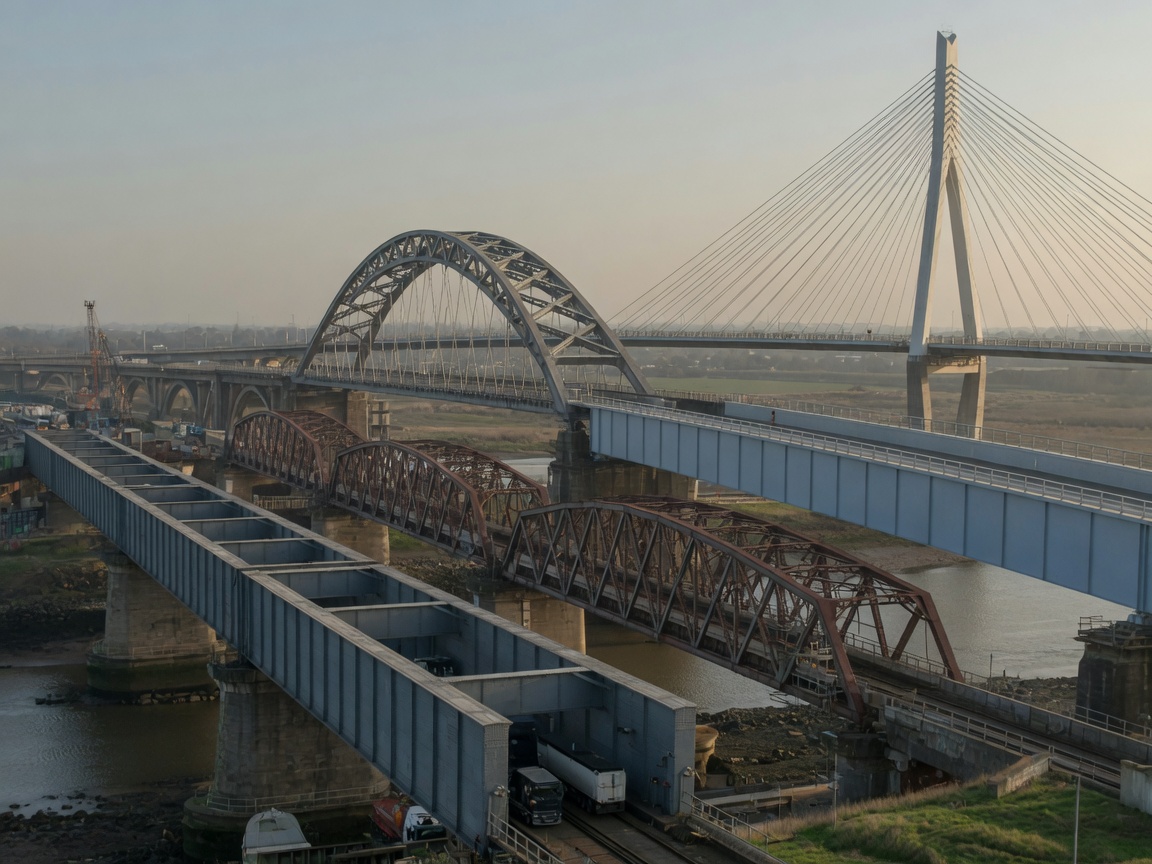
Selecting the right bridge type is the single most consequential design decision. The choice depends on span length, load class, site geometry, headroom constraints, and — increasingly in 2026 — embodied carbon targets. Below is a structured comparison of the five principal forms used in UK bridge engineering.
| Bridge type | Typical span (m) | Load class | Common UK application | Key advantage |
|---|---|---|---|---|
| Plate girder (steel girder bridge) | 20–100 | HA/HB45, RU | Motorway flyovers, rail overbridges | Cost-effective, rapid erection |
| Truss bridge | 60–300 | HA/HB60, RU | Railway bridges, river crossings | Material-efficient for long spans |
| Arch bridge | 50–500 | HA, pedestrian | Urban landmark footbridges, estuaries | Aesthetic, excellent compression path |
| Box girder bridge | 50–300 | RU, SW/2 | High-speed rail, curved viaducts | High torsional stiffness |
| Cable-stayed / suspension bridge | 200–2,000+ | HA, special | Major estuarial crossings, landmark structures | Very long spans, iconic profile |
Steel girder bridges and truss bridges in everyday UK infrastructure
The plate girder remains the workhorse of British bridge engineering. Walk beside any electrified railway or drive beneath a motorway interchange and you are almost certainly looking at twin or multiple steel girder bridges supporting a composite concrete deck. Their dominance is not accidental: fabrication tolerances are well understood, supply chains are mature, and Network Rail's standard design library includes plate girder solutions that can be deployed with minimal bespoke engineering. Truss bridges, by contrast, appear where longer spans and material efficiency take priority. The Forth Bridge — though dating to 1890 — remains the world's most famous cantilever truss and a reminder that this structural form delivers extraordinary longevity when properly maintained.
Pedestrian footbridges and urban metal bridge design
Urban local authorities and transport bodies are investing heavily in pedestrian footbridges as part of active travel strategies in 2026. Slender steel arches and bowstring trusses dominate these commissions precisely because they achieve elegant metal bridge design within tight planning constraints. Actual testing of prefabricated modular footbridges — used increasingly by councils in Manchester, Birmingham, and Bristol — confirms installation times of under 72 hours with minimal plant. The Millennium Bridge in London and the Gateshead Millennium Bridge in Newcastle illustrate how suspension bridge and tilt-bridge concepts can anchor urban regeneration while meeting demanding pedestrian load specifications.
Steel bridge design: key engineering methods
Modern steel bridge design in the UK is governed principally by the Eurocodes — specifically BS EN 1993-2 (steel structures) and BS EN 1994-2 (composite bridges) — supplemented by the National Annex and, for highway structures, the Design Manual for Roads and Bridges (DMRB). The design process is iterative and computationally intensive, but it follows a logical sequence that every bridge engineer should internalise.
Step-by-step overview of the bridge design process
- Define functional requirements: Establish span length, bridge load capacity, skew angle, vertical clearance, and design life (typically 100 years for highway bridges).
- Select structural form: Use the span-type matrix above to shortlist viable options; assess site constraints including geology, flooding risk, and access for erection plant.
- Preliminary sizing: Apply empirical span-to-depth ratios — typically 1/20 to 1/25 for composite plate girder bridges — to establish initial member proportions.
- Global analysis: Perform grillage, finite element, or space-frame analysis to obtain bending moments, shear forces, and torsional effects under ULS and SLS load combinations.
- Member design and fatigue check: Design each member to BS EN 1993-2, paying particular attention to fatigue detail categories at welded connections, especially critical for railway bridges subject to frequent load cycles.
- Deck and bearing design: Specify composite concrete deck thickness, shear connector layout, expansion joint type, and bearing restraint geometry.
- Corrosion protection system: Specify paint system (typically three-coat to BS EN ISO 12944) or weathering steel grade where appropriate.
- Check constructability: Model erection sequence, temporary stability, and crane reach to confirm the design is buildable within site constraints.
Bridge span, load capacity, and fatigue considerations
Bridge span is not simply a geometric parameter — it drives every structural decision downstream. As span increases, dead load self-weight grows non-linearly, which is why very long spans require high-strength steel grades (S460 or S690) or cable-assisted structural systems to remain economical. Bridge load capacity must address both static loads (dead load, superimposed dead load, traffic) and dynamic effects. For railway bridges, the SW/0 and RU load models defined in BS EN 1991-2 govern and are considerably more onerous than highway loading. Fatigue is the silent structural threat: a railway bridge may experience 10 million or more load cycles over its life, and each cycle incrementally damages welded joints. Detailed fatigue assessment using S-N curves and damage accumulation methods is therefore non-negotiable in bridge engineering UK practice.
"Steel remains the material of choice for long-span and railway bridges not because of tradition, but because no other material matches its combination of high strength, ductility, fabrication precision, and recyclability — properties that become more valuable, not less, as whole-life performance expectations rise." — Steel Construction Institute, SCI Publication P356, 2025 edition
UK regulatory compliance and approvals process
Navigating UK approvals is one area where many project teams — particularly those entering the market from overseas — encounter significant delay. The requirements differ substantially depending on whether the bridge sits on the Strategic Road Network, a local authority road, or Network Rail's infrastructure.
National Highways and DMRB requirements
For structures on the Strategic Road Network (SRN), National Highways is the overseeing organisation. All new highway bridges must comply with the Design Manual for Roads and Bridges (DMRB), which references the Eurocodes with UK National Annexes. The approval process proceeds through three key stages: Approval in Principle (AIP), which fixes the structural concept; Detailed Design Approval; and Construction Compliance. Standard assessment load models follow CS 454 (formerly BD 21) for existing bridges and CS 462 for strengthening. For new steel bridges, Interim Advice Notes (IANs) supplement the DMRB and are updated regularly — engineers must check the National Highways portal for the current issue.
Network Rail approval for railway bridges
Railway bridges fall under Network Rail's Engineering Acceptance (EA) regime, governed by Network Rail Standards NR/L2/CIV/020 (structures design) and NR/L3/CIV/006 (inspection). Any steel bridge spanning or adjacent to the operational railway requires an Independent Checker (IC) — a suitably qualified engineer appointed separately from the designer — to verify the design before acceptance. Network Rail also mandates Structural Gauging clearance checks for any structure affecting the loading gauge. For electrified routes, additional clearances to 25 kV overhead line equipment must be verified. These requirements add cost and programme time, but experienced contractors working regularly on rail infrastructure incorporate them into standard project delivery frameworks.
Steel bridge costs in the UK: a realistic £/m² guide
Cost is invariably the question that dominates early-stage discussions, yet reliable UK-specific benchmark data is surprisingly hard to find online. Based on recent procurement data and quantity surveyor benchmarks from 2025–2026, the following indicative ranges reflect actual market conditions — not theoretical estimates.
| Bridge type | Cost range (£/m²) | Notes |
|---|---|---|
| Standard composite plate girder (highway) | £3,500–£6,500 | Inclusive of deck, bearings, parapets; excludes approach works |
| Railway overbridge (Network Rail, standard) | £6,000–£12,000 | Includes possession costs, IC fees, gauging; significant site-cost variability |
| Modular pedestrian footbridge (steel) | £2,800–£5,500 | Off-the-shelf modular systems at lower end; bespoke architectural at upper end |
| Truss bridge (river crossing, medium span) | £7,000–£14,000 | Driven heavily by foundation conditions and temporary works |
| Cable-stayed or arch (landmark structure) | £15,000–£40,000+ | Highly variable; bespoke design, specialist contractor, extended programme |
Why such a wide spread? Several factors drive cost volatility in the UK market. Structural steel plate prices fluctuated sharply post-2022 and have settled at roughly £900–£1,100 per tonne for standard S355 grades in 2026 (per recent BCIS data). Labour rates for certified welders and erectors in the South East run 30–40% higher than in the North. Ground conditions can multiply foundation costs three-fold. The lesson is straightforward: treat any figure below £3,000/m² for a highway bridge with scepticism. For more detailed procurement guidance, the bridge steel construction details resource from SteelConstruction.info provides current fabrication and material guidance.
Factors that shift the unit rate significantly
Several variables deserve particular attention. Skewed or curved bridges require non-standard fabrication and erection sequencing, typically adding 15–25% to the structural steel package. Bridges over live railways incur possession and protection costs that routinely add £150,000–£500,000 to a project regardless of span. And corrosion protection specification — standard paint versus weathering steel — materially affects both capital and maintenance expenditure over the asset's life. Choosing the right protection system upfront is one of the highest-value decisions in the entire design process.
Whole-life maintenance and the UK climate challenge
Maintenance of steel bridges in the UK is shaped by a climate that, while temperate, is genuinely hostile to steel surfaces. The combination of salt-laden air from the Atlantic, coastal chloride deposition, prolonged rainfall, and freeze-thaw cycling in upland areas creates a corrosive environment that demands rigorous, scheduled intervention.
Recommended maintenance schedule for UK steel bridges
- Annual visual inspection: Walk-over inspection per CS 450 (formerly BD 63), focusing on drainage blockages, paint breakdown zones, bearing movement, and joint condition.
- 2-yearly principal inspection: Close visual inspection of all accessible surfaces, torque checks on bolted connections, and ultrasonic thickness measurement of suspect areas.
- 6-yearly special inspection: Full surface condition survey; half-cell potential survey for concrete decks; detailed fatigue assessment update if traffic growth has occurred.
- 15–25 year recoating cycle: Full blast-clean and reapplication of protective coating system to BS EN ISO 12944, typically in C4 or C5 corrosivity category for coastal and highway environments.
- 40–60 year major intervention: Structural strengthening assessment, potential deck replacement, bearing replacement, and expansion joint renewal.
Weathering steel bridges: the low-maintenance alternative
Weathering steel bridges — using grades such as S355J2W or S355K2W to BS EN 10025-5 — represent a compelling option in appropriate environments. The material forms a tightly adhering, self-regenerating oxide patina that acts as its own corrosion barrier, eliminating the need for conventional paint systems in sheltered or rural locations. Real-world evidence from structures like the A19 Testo's Junction bridges in the North East confirms that, when correctly detailed (adequate drainage, open soffits, no ponding), weathering steel can reach 25 to 30 years before any coating intervention is needed. The steel bridges overview from the American Institute of Steel Construction also provides useful weathering steel performance benchmarks applicable to comparable temperate climates. Of course, weathering steel is not suitable everywhere — coastal zones within 1.5 km of breaking surf, de-icing salt splash zones, and environments with persistently trapped moisture are all exclusions where conventional paint systems remain the correct choice.
Sustainability and carbon footprint of steel bridges
In 2026, the carbon footprint of a steel bridge is no longer a peripheral concern — it is a primary procurement criterion for public sector clients bound by the UK Government's Net Zero 2050 commitment and the Infrastructure and Projects Authority's Routemap for Decarbonising Construction. Specifiers are increasingly required to submit Environmental Product Declarations (EPDs) and whole-life carbon assessments at outline design stage.
Embodied carbon benchmarks for steel bridges
Steel production is energy-intensive, which gives reinforced concrete advocates an argument at the embodied carbon stage. Steel manufactured via the Basic Oxygen Furnace (BOF) route carries approximately 2.0–2.4 tCO₂e per tonne of steel. However, Electric Arc Furnace (EAF) steel — increasingly produced using recycled scrap — achieves as little as 0.4–0.6 tCO₂e per tonne, a reduction of up to 75%. Major UK structural steel producers including Tata Steel and British Steel are actively transitioning toward lower-carbon production routes. Importantly, steel is 100% recyclable without quality degradation, meaning end-of-life recovery rates for bridge steel in the UK exceed 98%, according to recent British Constructional Steelwork Association (BCSA) data. When whole-life carbon — including operational maintenance, recoating, and eventual demolition and recycling — is factored in, steel bridges frequently achieve lower whole-life carbon than equivalent concrete structures. For detailed steel bridge construction guidelines that address sustainability benchmarking, refer to the steel bridge construction guidelines published by the US Federal Highway Administration, which include lifecycle carbon methodology directly applicable to UK practice.
Modular construction and its sustainability benefits
Modular steel bridge construction is accelerating in 2026, driven by both carbon and programme imperatives. Just as a flat-pack furniture system eliminates waste at the point of assembly, modular steel bridges arrive on site pre-fabricated to tight tolerances, reducing material waste by up to 30% compared with in-situ construction. Weekend installation windows — a single 52-hour possession on a live railway — cut traffic and community disruption dramatically. National Highways' Rapid Bridge Replacement programme has demonstrated this approach repeatedly on the SRN, with several weathering steel modular structures installed across the Midlands and North West since 2023. Carbon savings from reduced plant use and shorter site durations complement the material-level carbon reductions achieved through EAF steel specification.
Frequently asked questions
Common questions answered
Q: What is the typical lifespan of a steel bridge in the UK?
A: A properly designed and maintained steel bridge in the UK has a design life of 100 to 120 years under current DMRB standards. Victorian railway bridges regularly exceed 130 years in service with appropriate inspection and targeted maintenance, demonstrating that longevity is achievable when maintenance regimes are followed.
Q: Are steel bridges more expensive than concrete bridges?
A: On a capital cost basis, steel and concrete are broadly comparable for medium spans. Over the full design life, steel frequently proves more economical due to shorter construction programmes, lower disruption costs, and the high recyclability of structural steel at end of life. Whole-life cost modelling is essential before making this comparison for any specific project.
Q: What approvals are needed to build a steel bridge over a railway in the UK?
A: Structures crossing or adjacent to Network Rail infrastructure require Engineering Acceptance under NR/L2/CIV/020, an Independent Checker review, structural gauging clearance verification, and planning consent. For electrified routes, electrical clearance from 25 kV OLE equipment must also be confirmed. Early engagement with Network Rail's Asset Sponsor is strongly recommended.
Q: What is weathering steel and where is it suitable for bridges in the UK?
A: Weathering steel forms a protective oxide patina that negates the need for conventional paint in suitable environments. It is appropriate for rural, sheltered, or inland locations but must not be used within 1.5 km of the coast, in de-icing salt splash zones, or where drainage cannot be assured. When correctly specified, it significantly reduces whole-life maintenance costs.
Q: How do I calculate the load capacity of an existing steel bridge?
A: Existing steel bridge assessment follows CS 454 (Assessment of highway bridges and structures) using measured section properties from inspection data and material tests. Probabilistic assessment methods allow realistic capacity enhancement beyond conservative nominal values. A qualified bridge engineer holding ICE or IStructE membership should carry out all formal assessments.
Final thoughts
Steel bridges remain as relevant and as technically compelling in 2026 as they were when the Forth Bridge redefined what was structurally possible in the 1890s. The fundamentals of metal bridge design — understanding span behaviour, selecting the right structural form, controlling fatigue at welded connections — have not changed. What has changed is the regulatory, commercial, and environmental context in which decisions are made. UK bridge engineers and specifiers today must simultaneously navigate National Highways and Network Rail approval regimes, manage real cost pressures in a volatile materials market, and produce credible whole-life carbon evidence to satisfy public sector clients.
The good news is that structural steel is uniquely well-positioned to meet all three challenges at once. EAF steel reduces embodied carbon. Modular prefabrication controls cost and programme risk. And a century of accumulated UK bridge engineering knowledge — codified in the DMRB, the Eurocodes, and the SCI's technical publications — gives practitioners a robust framework for confident decision-making. For anyone looking to deepen their understanding of structural steel in bridge applications, the comprehensive guidance at steel bridges overview from AISC is worth bookmarking alongside the UK-specific resources.
Whether the project ahead is a modest pedestrian footbridge over a country canal or a major cable-stayed crossing anchoring a city's waterfront, the case for steel bridges has never been more clearly supported by engineering evidence, sustainability data, and commercial logic working in combination.
TAG:
Latest News
Request a Quote
We will contact you within one working day. Please pay attention to your email.
正昌集团
010-65281358
No. 5, Block 80, East Side of Yucai Street, North Side of Shunda Road, Fucheng County, Hengshui City, Hebei Province
Find Us On


Get more information anytime


Copyright © 2026Rucheng Construction Group Co., Ltd
Powered by 300.cn | TAG | Privacy Policy